Topic: Marketing Effectiveness

EFS Marketing Effectiveness: campaigns that produce completed patient action.

Healthcare SEO: Google Tips for June 2017

A Look at the Latest Google Tips That Affect SEO for Hospitals and Medical Practices

With just one more week before Independence Day, some might be entering the lazy days of summer—which, unfortunately, does not apply for healthcare SEO marketers! As we do each month, we have gathered the latest healthcare SEO Google tips that affect SEO hospitals and medical practices. And as always, the emphasis is on information for healthcare digital marketers that don’t monitor every event related to medical SEO.

Google SERP Snippets No Longer Use DMOZ

Snippets are the content that appear under the title in a search engine results page (SERP). As the Official Google Webmaster Central Blog explained, until recently, Google got that information from one of three sources—one of which, DMOZ.org, no longer exists, and thus, is no longer a source. The takeaway: If your hospital’s Website has been relying on DMOZ for snippets—or for that matter, another of the sources, page content—now is the time to explore the third source which gives you complete control of what appears in a snippet: description metadata. This is particularly true for high-volume pages or pages for which you heavily compete with other hospitals. Google’s “Create Good Titles and Snippets” is a solid place to start if you have never explored the description metadata—as well as providing instructions for how to prevent displaying a Snippet.
[poll id=”13″]

Google My Business Introduces New “Posts” Feature

Although a small announcement, there are some massive possibilities for hospitals to take advantage of the new Posts feature on Google My Business. As the Google Small Business Blog explains, you can:
“…publish your events, products, and services directly to Google Search and Maps. By creating posts, you can place your timely content in front of customers when they find your business listing on Google.”
The takeaway: Google has been routinely improving My Business, which we’ve been following for months. In fact, along with frequent mentions in my monthly blog, we published “Top 2016 Google My Business Listing Changes for Online Healthcare Marketers” last December. So, if you have not yet established a My Business page (or pages, for matter) for your hospital, it might be worth your while since Google is clearly interested in making it a productive marketing tool. But, if you have already started exploring My Business, it could be an excellent way to engage new patients, especially if your analytics are demonstrating any type of traction for views but are not getting solid clickthroughs.

Google AdWords Launches New “Smart Bidding” Option to Maximize Conversions

If you use Google AdWords for your hospital pay-per-click (PPC) marketing, you likely have campaigns with Google AdWords—which means you are probably familiar with its various Smart Bidding options (i.e., “Target CPA,” “Target ROAS” and “Enhanced CPC”). There is now a new option, “Maximize Conversions,” that can be very useful for building hospital brand awareness. The takeaway: Usually, conversion-driven PPC campaigns have relatively higher budgets because they can be tied to metrics that demonstrate a campaign’s value and ROI. Therefore, this new Smart Bidding feature can be tremendously advantageous for healthcare PPC strategies that are designed to not only increase hospital Website traffic, but to leverage that traffic with conversions that ideally move visitors into the so-called “sales funnel.”
As Guideway Care Associate Director of Search Engine Marketing, Susan Gullion is one of our most knowledgeable resources for enhancing our healthcare clients’ search engine marketing strategies with SEO, PPC and social media. Guideway Care is a cloud-based technology and services company that improves profitability and patient outcomes for hospitals and practices through end-to-end patient engagement solutions backed by clinical and non-clinical teams. Its HIPAA-compliant, SaaS platform improves care team workflows, automates patient communication and tracks patient progress to optimize the patient journey. Since 2004, leading healthcare providers have trusted Guideway Care to help acquire, manage and engage patients through complex episodes of care.

Let’s Talk: Virtual Personal Assistants and Medical SEO

“Hey, Siri!” “”Hey Alexa!” Even if you don’t use these commands to interact with virtual personal assistants like Apple’s Siri mobile app and Amazon’s Echo “smart speaker,” you likely have heard them on their respective TV commercials or have personally witnessed people uttering those and similar phrases into their “knowledge navigator” devices to get information. Although not yet a universal best practice for healthcare marketers—even for those actively involved with in hospital Website’s search engine optimization (SEO)—the continued adoption of intelligent personal assistant technologies ensure that medical SEO techniques will soon merge with personal assistant search optimization (PASO) as part of healthcare digital marketing strategy best practices.
[poll id=”8″]
A 2014 Google blog, “OMG! Mobile Voice Survey Reveals Teens Love to Talk,” noted 41 percent of adults rely on voice searches at least once per day—with more than half of all teens reportedly turning to personal digital assistants daily for help with locating information. Presumably, as smartphones (and the virtual personal assistant technologies they provide) have become even more commoditized, it’s a safe assumption that voice search rates have grown too. Another safe presumption is users will use increasingly rely upon virtual personal assistants for finding healthcare information. For instance, a person driving to work that suddenly remembers they haven’t had a physical in years might ask Siri about available physicians. Or, someone out with friends that experiences an injury might turn to Google Assistant to locate an urgent care facility. Or, a mother worried about her child at night might turn to the mobile device on the bedside table to ask about symptoms. But no matter who (or what) is doing the knowledge navigation, the location of that data remains the same: on the Internet. And thus, the advantages of search optimization also remain the same. Therefore, the time is now to start understanding how healthcare SEO and PASO can help healthcare organizations improve their online efforts for patient acquisition and patient engagement.

Additional Advantages of Medical SEO for Virtual Personal Assistants

So, there’s no doubt that implementing your existing medical SEO strategies for the new virtual personal assistant audience is an opportunity to find new patients (and for them to find you!). However, those that embrace this sooner than later will likely reap additional rewards. Here are a few reasons why:

• Currently, virtual personal assistant search results tend only yield a few links—as compared to traditional Web-browser searches that can produce hundreds—if not thousands — of results. (For example Siri on average returns one to four links per search.) This indicates the current competition to preferred rankings is not very fierce, which naturally suggests it can be very easy to achieve top medical SEO rankings.

• Intelligent personal assistant searches are often filtered through additional artificial intelligence technologies, which mean the results are more likely to be custom tailored to the user. As such, the opportunity to develop highly personalized results may likely result in impressive click-through rates. This is likely to become even more true as the technologies improve.

• Because search engine algorithms are routinely adjusted to embrace new ways for users to find relevant information—not to mention the potential boosts in a hospital Website’s traffic and engagement— it’s entirely possible that early adopters of medical SEO for virtual personal assistants may see overall increases in their Website’s search engine result page rankings.

Challenges of Healthcare SEO for Intelligent Personal Assistants

• Keyword and result strategies: Unfortunately, healthcare SEO for intelligent personal assistants does not mean a simple transfer of keywords and calls to action. This is primarily due to the differences in how a browser-based search will return search results in comparison to a virtual personal assistant.

The easiest way to describe this is the balance of quality versus quantity. Of course, all search engines strive to provide quality results, but virtual personal assistants will make additional pressure to provide a limited quantity. After all, a Web-browser user can quickly scan results on page, open multiple links, conduct another search, etc. the voice-based results from a virtual personal assistant will not have that luxury. For instance, if a user asks Siri where to find an ENT, preferred results will verbally provide one or two resources, rather than a recital of a full Internet scour.

• Terminology and nomenclature: Most search engines are “smart” enough to detect misspellings and suggest appropriate searches. However, this may be a problem for the still-not-perfect accuracy of voice recognition when coupled with the demanding language requirements for some medical searches.

• Voice inflections: Finally, medical providers must also keep up with the capabilities of current search technologies so they know how best to leverage it for patient engagement and assistance. As explained in an mHealth Intellgence article, “mHealth Takes a Closer Look at Digital Assistant,” there are concerns about the technology’s current inability to recognize emotional distress and respond accordingly. Consequently, patients might query with symptoms and be provided with completely irrelevant—and sometimes irreverent — responses, which could exacerbate emergencies.


As Guideway Care Associate Director of Search Engine Marketing, Susan Gullion is one of our most knowledgeable resources for enhancing our healthcare clients’ search engine marketing strategies with SEO, PPC and social media. Please contact us to learn more about how Guideway Care can partner with you to develop a custom healthcare search engine marketing solution.

Healthcare SEO: Google Tips for May 2017

A Look at the Latest Google Tips That Affect SEO for Hospitals and Medical Practices

We hope your hospital or medical practice is having a wonderful Spring! As we do each month, we have gathered the latest healthcare SEO Google tips that affect SEO hospitals and medical practices. And as always, the emphasis is on information for healthcare digital marketers that don’t monitor every event related to medical SEO.

Google Analytics Home and Google Data Studio

If your healthcare SEO strategy only looks at Website performance metrics on a limited basis—perhaps because you don’t have time or because you find analytics to be tedious and difficult—Google has recently upgraded and expanded two of its analytics tools that may encourage or enable you to use data to improve your medical SEO. First, Google Analytics: Last month, Google published “The New Google Analytics Home: Know Your Data,” in which it announced a redesigned “Home” page intended to provide “an overview of key aspects of your business’ online presence.” Second, Google Data Studio: In March, Google published “Data Studio now globally available,” in which it announced unlimited reports (instead of the previous limit of five) for its new “beta” analytics tool. This innovative tool collects data from multiple sources (e.g., your Website, Facebook page, YouTube page) and lets the user create customizable dashboards for presentations or reports. The takeaway: It’s very easy to slip into “analysis paralysis” with Google Analytics—a testament to the depth and complexity of data it can provide. The simplified Google Analytics Home page’s simple dashboard may be a blessing for the aforementioned digital healthcare marketers that need quick and easy-to-digest information or for the more advanced medical SEO’er prone to unproductive analysis paralysis. Likewise, the continued development of Google Data Studio may also be a blessing for digital healthcare marketers in either the “inexperienced or too busy” or “experienced over-thinker” camps of healthcare SEO. This is particularly true in the age of healthcare content marketing and healthcare social media marketing, which, like a hospital Website’s SEO, can be improved with performance data analysis.

New “How Google Search Works”

Search Engine Roundtable.com recently published “Google Updates Their ‘How Search Works’ Site,” which links to a redesigned guide that may be of interest to anybody involved in SEO for hospitals, but particularly anybody new to healthcare SEO. The takeaway: It could be argued that knowing how Google search works is worth knowing just for the intellectual curiosity about one of the most important technologies ever created and that affects virtually everybody’s lives. But for the novice digital healthcare marketer that wants to improve their medical SEO acumen, there may be tremendous advantage to having a better understanding of how search engines (especially Google’s) work.

Improved Granular Review in Google Local Listings

Search Engine Roundtable.com also published “Google Adds More Granular Review Filtering In Local Listings” in which it explained that rather than “full star” ratings (e.g., four stars), Google now lets users filter with “half stars” (e.g., 4.5 stars). However, what made this article so compelling was what one reader wrote in the comments:
“The main problem remains and that is that Google’s reviews are filled with fakes written either by marketers stuffing their client’s with raving reviews (or negatives for their competitors) or reviews written by the business owner themselves. This problem undermines the rating process as a whole and will only get worse before Google comes up with some sort of solution, if one exists…”
The takeaway: Call it what you want—cheating, unethical, “black hat”—there will always be people that want to game the system. Here, it’s with fake reviews…and yes, it does undermine the rating process. However, it is arguable that the problem “will only get worse before Google comes up with some sort of solution.” The only certain “solution” would be to eliminate review filtering, which benefits nobody. Instead, a more appropriate suggestion would be to not engage in such practices to market your hospital online. Although there might be some short-term gains—especially if your hospital is in very competitive market and may rely upon comparatively higher ratings to attract new patients—eventually, the heightened expectations will result in negative reviews.
As Guideway Care Associate Director of Search Engine Marketing, Susan Gullion is one of our most knowledgeable resources for enhancing our healthcare clients’ search engine marketing strategies with SEO, PPC and social media. Please contact us to learn more about how Guideway Care can partner with you to develop a custom healthcare search engine marketing solution.

Getting Personal: Making the Most of Social Media in Healthcare with Facebook Bots and Facebook Live

Recent developments in using social media for health are now enabling hospitals and clinics to make personal connections like never before, notable because social media—and Facebook in particular—has been routinely rejected by marketers from many sectors due to its impersonality. However, Facebook’s recent innovations are now providing capabilities that are perfect for healthcare marketing and communications, enabling hospital administrators and doctors to provide more personal levels of customer care. From profiling staff members to promoting services to distributing timely healthcare information, Facebook bots and Facebook Live are emerging as preferred social media healthcare marketing tools. And when used properly, they can significantly improve patient engagement outcomes. Here are some examples.

Healthcare Marketing with Facebook Live

Facebook Live enables healthcare marketers and staff to use video to interact with patients in real time. It is ideal for communicating the services and benefits that differentiate your healthcare facility from others. For instance, does your hospital or clinic have difficulty promoting or explaining:

• Specialized medical equipment?

• A unique focus on conditions and treatments?

• Trendsetting procedures?

Facebook Live can be used to put the spotlight on these sorts of features, allowing patients to better understand what sets your healthcare facility apart from another. With this type of information on hand, prospective patients will be better able to make appropriate care decisions while hopefully prioritizing your practice in particular.

Scheduling Doctor Appointments with Facebook Bots

Facebook bots are customizable programs that automate tasks. For example, scheduling doctor appointments no longer require a patient to call your staff and use valuable time to perform a relatively simple activity. Instead, Facebook bots can handle this task, letting patients send a simple message to get the ball rolling. This functionality has the added advantage of minimizing back office requirements, which streamlines your scheduling process without human assistance.

Checking Medical Test Results with Facebook Bots

There are many digital platforms that can now manage medical test results (like the popular MyChart phone app), so why not let Facebook be one more? When patients contact you via Facebook, a bot can provide access to results and medical data through a confidential portal. A fast and convenient alternative to paper results, this sort of system can offer a better substitute without the need for a follow-up appointment. This option can also be used to request copies of medical records, guiding patients to a records request process that can allow for a quick transfer of necessary documentation.

Refiling Expired Prescriptions with Facebook Bots

When a patient’s prescription is out of refills, he or she often ends up in a game of phone tag between the local pharmacy and his or her doctor’s office, desperately seeking a new script. A Facebook bot can simplify this process, automatically tapping into recordkeeping systems to let doctors know that their patients require assistance. A simple keyword system is all that is needed here; when patients provide a prescription number or other piece of contact information, bots can quickly and efficiently run interference to ensure consistent access to medication.

Providing Healthcare Information with Facebook Bots

When it comes to health information, many patients have more questions than answers. Oftentimes, seeking responses to queries means going to Google and doing general research with unreliable results, but chatbots can make this much easier and accurate. Instead of looking up information on the medical services you provide, customers can go to your Facebook page and get an automated response in seconds. Likewise, they can get answers about health information ranging from simple medical questions (like the definition and symptoms of a disease) to more complex treatment information.

Considerations for Using Facebook Bots and Facebook Live

• Privacy Issues and HIPAA Compliance: HIPAA is a critical issue in all areas of doctor-patient communications, and the legal protections surrounding confidential information are exceptionally serious. Medical practices implementing a chatbot system must be extremely careful to stay compliant under this law, ensuring that no access to personal data is directly available, or perhaps available at all without stringent verification of identity.

• Emergency Services: As many healthcare professionals know, calling 911 is the best way to seek help in an emergency that requires medical care. Information to this end is usually available on hospital scheduling hotlines, Websites, social media pages and more, safeguarding providers against legal liability in the event that patients attempt to proceed with scheduling an appointment or seeking help online rather than calling emergency services. Any use of a chatbot will also need to take this information under consideration, implementing proper safety checks to ensure patients seeking immediate help are provided with the proper instructions.

• Misinformation: Medical information provided by doctors is generally personalized to a particular patient’s needs, as not all advice can be applied universally. Information communicated through a chatbot will have to reflect these disclaimers as well, letting patients know clearly that any information made available is not specific and should not serve as a substitute for seeing a medical professional.


As Guideway Care Associate Director of Search Engine Marketing, Susan Gullion is one of our most knowledgeable resources for enhancing our healthcare clients’ search engine marketing strategies with SEO, PPC and social media. Please contact us to learn more about how Guideway Care can partner with you to develop a custom healthcare social media marketing solution.

Does Your Hospital Website Actually Serve Visitors?

Seven Questions That All Hospital Website Administrators and Marketers Should be Asking

It’s occasionally uncomfortable to think of patients and other hospital Website visitors as “customers,” but it does help to use that perspective when trying to understand how a hospital or healthcare Website can better serve its audience. MarketingLand.com recently published “7 Questions Your Customers Ask, and How Your Website Must Answer,” an excellent model for gauging how well your hospital Website is serving its “customers.” The following is a list of those questions, but positioned for hospital Websites and its audiences.
[poll id=”4″]

Why Does Your Hospital Deserve My “Business”?

Again, it’s a bit odd to describe healthcare as “business” for “customers,” especially for somebody that isn’t just looking for a great deal on an HDTV or a hotel room, but instead, is trying to figure out the best place to everything from preventative care to urgent care to treatment for chronic illnesses. However, people often have choices when making healthcare decisions, and “7 Questions” was correct in asking this important question: Why does your hospital deserve somebody’s business? It suggested some ways to begin to answer the question, including:

• Value Proposition: Almost without exception, your hospital’s marketing team has carefully crafted a mission statement and/value proposition statement that concisely explains its goals, benefits and differentiators. Likely, it appears on your Website’s homepage. But does the rest of your Website support those statements? If so, how and where?

• Longevity: If your hospital has been around longer than others in your area, that should be promoted as an indication of its quality and community support. However, this can work another way, too: If you are a new, cutting-edge facility, promoting your innovative spirit can be highly advantageous.

• Success Stories: Hospitals have multiple avenues to demonstrate its proven ability to deliver quality care! Among them are:

• Patient Testimonials

• Awards and Honors

• Case Studies and Clinical Trial Reports

What Makes Your Hospital Different?

As “7 Questions” was quick to point out, “this is similar to the question [about deserving your business, but it’s directed toward the products or services you offer, rather than your company.” For hospitals, it might seem difficult to separate the whole from the sum of its parts, but it’s important for each of your hospital’s services and institutes communicate their own unique mission and value statements (which should also support those of the hospital). How well do each and all of them do that? Again, “7 Questions” provided some concepts to consider in this regard:

• Approach: How do each of your services adopt, embrace or integrate your hospital’s UVP into its own approach?

• Quality: What standards of quality—aside from those proscribed by the hospital—does each service use to demonstrate its proficiency or excellence?

• Difference: What makes the service different (or better) than others available to the same audience?

Can Your Hospital Help Me?

At first glance, this could seem like a ridiculous or even rhetorical question…because one would hope that a hospital can indeed help somebody! But give it some thought and think back to the last question about what makes your hospital and services different. No hospital can help everybody and/or everywhere. This covers everything from:

• Geography: Do you primarily serve parts of your city, county, state or region? Is your Website accurately explaining this?

• Services: Along with providing a comprehensive list of the services your hospital offers, does it also do so in a manner that is accurate and benefits both you and your audience? For instance, if your “sports medicine” or “chronic care management” department is one of the smallest in your hospital, it probably shouldn’t be heavily promoted.

• Customer Service: This will be explored in more detail later, but for now: How easily and accurately does your Website help people find answers—be it FAQs about parking to accessing one’s nurses or doctors?

How Can I Justify Your Hospital’s Value?

The “Seven Questions” article originally positioned this question as “How Can I Justify This Purchase,” but it’s not an appropriate fit in the context of healthcare. Likewise, hospital Websites don’t have “menus” or “shopping carts” that itemize what it offers and how much it costs. Instead, it’s better to think of this question in terms of value, a concept that exceeds mere dollars and cents. In what ways does your hospital’s Website give people reason to consider your facility as their best choice for their healthcare needs? Among the ways “7 Questions” provides for others to answer this question, one in particular stands out as exceptionally valid for hospital Websites: solutions. Ponder this beyond the obvious “you are sick and we can make you well” problem/solution paradigm. Instead, as you did in your value proposition where you identified what makes you special and why you are the best choice for your patients, ask “What makes our patients special and what problems do they have that are unique?”

Where Do I Go From Here?

“7 Questions” positioned this question as one where “the shopper is ready to proceed. Now what?” Although it is never in good taste to think of patients as “shoppers” or “customers,” it is fair and important to be able to answer “Now what?”, especially for hospital Website visitors. Answering this shouldn’t be too difficult; it just requires an understanding of why people come to you (which includes on the phone, online or in-person) and how your Website can either provide an option or make the process easier to:

• Get Medical Attention

• Schedule Appointments

• Refill Prescriptions

• Get More Information

What Do I Do If I Have a Problem?

For hospitals, there are two ways to conceptualize this question:

• Medical or Clinical Problems: These problems can range from somebody that needs basic advice from clinician so that a trip to the ER or urgent care can be avoided to post-surgical/post-release questions that don’t justify calling 911 or cannot wait for the next available appointment. Does your hospital (or your hospital Website) have call centers, online support, etc. or other technologies/services for these scenarios…and if so, how easily is it to find and access them through your Website?

• Customer Service Problems: Remember that your hospital serves two distinct groups: patients and visitors. Much of what’s been discussed has focused on patients, but satisfying the needs of visitors is an important one too. For instance, is getting to your hospital—or parking at it—difficult? How well does your hospital Website explain transportation-related information?

Can I Trust Your Hospital?

The article said, “Ultimately, every question above boils down to this very one.” For hospitals, this could not be more of an understatement! Without getting too philosophical, it’s best to say that trust is something earned. So, in that context, how can a hospital demonstrate that on its Website? The article offered several suggestions that are valid for hospitals:

• Organization Memberships: Your hospital—and its services and institutes—all likely belong to multiple organizations that indicate a commitment to high standards. Are they mentioned on your Website? Does the Website make it easy for visitors to engage those organizations to learn more about you?

• Industry Recognition: As mentioned in “Why Does Your Hospital Deserve My Business,” awards and honors that build confidence in your hospital can be instrumental in establishing trust.

• Policies: How does your hospital ensure that key issues like patient rights and privacy are more than just words on a page (be it print or online)?

• About Us: Most hospital Websites at least provide some background information about its history and its doctors, but again, how well does your Website communicate this information? Is it enough for visitors to have trust in you (and to answer other questions)?


Derek Rudnak is a freelance healthcare marketing content creator that frequently contributes exclusive blogs to Guideway Care. Guideway Care is a recognized leader for innovative healthcare marketing solutions— which include inbound content marketing for hospitals. To learn more about how we can develop and implement a healthcare content marketing solution for you, please contact us.

Google Tips for Hospital Website Admins: February 2017

February 2017 was a relatively quiet month for Google, at least in the context of critical Google tips for hospital Website administrators as they relate to services such as Maps, My Business, etc. That doesn’t mean there wasn’t any activity that caught the attention of the hardcore Google watchdogs and bloggers, especially in the context of Google algorithms. For instance, Search Engine Roundtable’s “New Google Algorithm Update Targets PBNs & Links, Penguin Tweak?” identified an update that seemed to heavily target “black hat” SEO practices, which is best defined as very aggressive SEO techniques that aim to game the system for maximum search engine result page (SERP) results, rather than to develop content that has markedly more legitimate function and interest for Website visitors. However, as per the usual theme of this monthly blog, we prefer to focus on tips and updates for busy hospital Website admins that avoid intensive analysis and revisions to SEO best practices. In that context, there were some very interesting news and discussions that certainly warrant their inclusion here.

How to Use Google Maps and the “New Restaurant Model” for Improving Hospital Visibility

Search Engine Land recently published a superb article, “5 Ways You Can Improve Your New Business’s Visibility on Google Maps.” Rather than regurgitating its simple yet well thought-out tips that used new restaurants as a control in a model to validate its premises, you are encouraged to clickthrough and read it. However, if you need the motivation to explore this very important component of a successful online hospital marketing strategy, consider these figures from the article:

• Google controls 95 percent of mobile search market share.

• Google Maps overtook the Google Search app for fourth place in number of unique visitors with over 95 million users. It trails only Facebook, Messenger and YouTube in unique visitors.

And thus, as the article smartly concludes, “that means appearing in Google map results is critical for local businesses.” The takeaway: Advice for how to improve hospital visibility with Google Maps that also does so in the context of “local business” is invaluable for hospitals and clinics. Although it may not pertain as much for healthcare facilities that have a wide audience (e.g., national or multi-state regions), it’s arguable that such facilities aren’t as reliant on Google Maps for visibility because they often have large budgets for advertising and other techniques for building brand awareness.

Google Spaces Closing Down

Don’t worry if you never heard of Google Spaces, because it was only introduced a matter of months ago. However, if you were one of the ambitious online hospital marketers that adopted it, you should be aware that it will be shut down on April 17, 2017. The takeaway: As of March 3, 2017, Spaces is read-only—which per Google, “means you can’t create new spaces, posts or comments. Also, new invitations can’t be sent, and new members can’t be added to spaces.” You’ve got until April 17 until your content disappears forever. Until then, you can still see, save or delete—with the last option probably being the wisest. As the saying goes, “the Internet is forever,” and it’s best to not let content that you will soon forget about potentially reemerge at a later time.
As Guideway Care Associate Director of Search Engine Marketing, Susan Gullion is one of our most knowledgeable resources for enhancing our healthcare clients’ search engine marketing strategies with SEO, PPC and social media. Please contact us to learn more about how Guideway Care can partner with you to develop a custom healthcare search engine marketing solution.

Easy Ways You Can Support Colorectal Cancer Awareness Month in March 2017

[tweet “… easy and quick tips to support the cause and engage with your facility’s patients.”] Once again, we are putting a spotlight on this month’s national health observance—which for March 2017 is Colorectal Cancer Month—so that busy hospital and clinic marketing teams can get some easy and quick tips to support the cause and engage with their facility’s patients. Normally we wouldn’t be as explicit about previous month’s observances, however, there are some striking consistencies what we wrote last month about supporting American Heart Month. The first relates to why we tailored this and last month’s content for bariatric surgery centers. Most simply a significant percentage of partners are bariatric surgery centers, although we provide patient management solutions for all types of hospitals and clinics. Thus, we are again positioning our tips for bariatric surgery center marketing and patient management—however, they can easily be used by general healthcare providers and many other specialties or centers of excellence.

Linking Bariatric Surgery with Colorectal Cancer

The second consistency may seem redundant if you read last month’s blog, but we assure you, it’s not! However, as with heart disease, there are very real connections between colorectal cancer and bariatric surgery (which includes patients with obesity and diabetes). And like we said last month, don’t just take our word for it! According to the National Cancer Institute’s “Cancer Fact Sheet”,
“People who are obese are slightly (about 30%) more likely to develop colorectal cancer than normal-weight people”
and
“A higher BMI is associated with increased risks of colon and rectal cancers in both men and in women, but the increases are higher in men than in women.”
Additionally, the NCI said “the United States had the highest fractions attributable to overweight/obesity for colorectal cancer, pancreatic cancer, and postmenopausal breast cancer and “that obesity may worsen several aspects of cancer survivorship.” It should not be difficult see to detect a pattern: Untreated or poorly managed patients with obesity and diabetes are at greater risk for developing other health problems that either can be prevented or treated with bariatric surgery.

Promote Your Bariatric Surgery Center’s Colorectal Cancer Programs

[tweet “…your bariatric surgery center can modify or repurpose existing programs, content and collateral.”] The third consistency is practically a facsimile of what we wrote last month about how your bariatric surgery center can modify or repurpose existing programs, online content and print collateral that relate to lifestyle improvements that can directly or indirectly improve heart health. This includes several suggestions from the National Health Information Center’s American Heart Month Toolkit such as:

• Better weight management

• Controlling cholesterol and blood pressure

• Drinking alcohol only in moderation

• Quitting smoking and avoiding secondhand smoke

Create Colorectal Cancer Screening Campaigns

The Centers for Disease Control has created the Screen for Life: National Colorectal Cancer Action Campaign which was designed to inform men and women aged 50 years and older about the importance of having regular colorectal cancer screening tests. Unfortunately, as the CDC explains, “about one-third of adults aged 50 or older (about 22 million people)—the age group at greatest risk of developing colorectal cancer—have not been screened as recommended.” The CDC provides virtually everything you need to develop a colorectal cancer screening campaign, including:

• Buttons and Badges

• Campaign Research

• Colorectal Cancer Quiz

• Personal Screening Stories

• Print Materials

• Public Service Announcements

• Resource Toolkit

• “Screening Helps Prevent Colorectal Cancer” Infographic

• Social Media Posts and Images

Another way to reach patients is to explore automated phone calls and text messages, which we very recently explored in our most recent blog, “Automated Phone Calls and Texts Can Improve Patient Outcomes.” (In fact, one of the examples mentioned was a study about how automated phone calls got 578 patients to schedule colon cancer screenings, which led to the diagnosis of pre-cancerous polyps in an estimated 145 patients…25 percent rate of detection!) [tweet “Another way to reach patients is to explore automated phone calls and text messages…”]

Use Social Media for #ColorectalCancerAwarenessMonth

Along with using social media to share and find useful information related to American Heart Month (including trending hashtags such as #colorectalcancerawarenessmonth and #80by18 and #getscreened), it’s also an excellent opportunity to expand your networks. For instance, if you don’t already, here are some worthy Twitter accounts you might want to follow:

• @preventcancer, the official Twitter page for the Prevent Cancer Foundation, the only U.S. nonprofit organization solely devoted to cancer prevention and early detection.

• @CDCgov, the official Twitter page for the Centers for Disease Control

Not sure what to post in your Tweets (or on Facebook, Pinterest or Instagram)? The CDC has created a list of suggested social posts and images that can get you in the right direction!
Guideway Care proudly supports Colorectal Cancer Awareness Month. For more about our company and our patient management platform Sequence, please contact us.

Google Tips for Hospital Website Admins: January 2017

One of our final blogs for 2016 was Top 2016 Google My Business Listing Changes for Online Healthcare Marketers, in which we listed key changes and new features that will help hospital Website administrators and online marketers prioritize their workflows and develop strategies for 2017. Due to the positive feedback from busy hospital marketers that can’t or don’t keep up with the seemingly endless updates—whether officially by Google or from a cadre of bloggers that scrutinize every perceived Google change—we thought it would be better to share a monthly digest of the most crucial tips. Along with covering My Business in our Google tips, we will be including all the Google technologies that we monitor, including new SEO algorithms, significant Chrome browser updates and more. [tweet “…our Google tips include new SEO algorithms, significant Chrome browser updates and more.”]

Chrome 56 part I: TLS/SSL “Shaming”

Another of our final 2016 blogs was Is Your Hospital Website Secure Enough for Google in 2017? In which we explained how Google would begin “shaming” Websites that weren’t using TLS/SSL security and how it might influence your SEO rankings. Late in January, Google rolled out the latest version of its Chrome browser, dubbed “Chrome 56.” As expected, the new Chrome shows a “Not Secure” label in the address bar of any Website not in compliance. The takeaway: If your hospital Website doesn’t collect passwords or credit card information, then you are OK—for the moment. However, as Google said in its blog Chrome 56 Beta: “Not Secure” warning, Web Bluetooth, and CSS position: sticky, there’s “a long-term plan to mark all HTTP sites as non-secure,” which means if you are not yet using TLS/SSL, it’s again time to think about updating your Website (for which we provided solutions in our aforementioned blog). [tweet “…if you are not yet using TLS/SSL, it’s again time to think about updating your Website.”]

Chrome 56 part II: HTML5 and Auto-Disabling Flash

The new Chrome also has another twist: Because it uses HTML5, which auto-disables Adobe Flash, as discussed in another Google blog, New in Chrome 56. This should also be of significant concern to hospital Website administrators that use Flash to create a more robust experience for patients and guests. Note it doesn’t eliminate Flash functionality. Your hospital Website users “will be prompted to run Flash on sites they’ve never visited,” which could be a minor nuisance, as well as an unfavorable impression for your brand. The takeaway: If your hospital Website uses Flash, now is the time to think about converting to other technologies and/or evaluating the importance of your Flash-driven content. [tweet “If your hospital Website uses Flash, think about converting and/or evaluating your content.”]

Get Ready for Google’s Interstitial Ad Penalties

As explained in more detail in Site Pro News.com’s Google’s Intrusive Interstitial Update Now Live, Google will soon likely penalize Websites that use interstitial ads, which the article identifies as anything that:

• Blocks a page

• Makes content unreadable

• Pops up without interaction

• Isn’t responsive (meaning it’s difficult or impossible to close on a mobile platform)

• Bothers people

• Annoys people

The takeaway: This is primarily intended to make mobile users’ experiences better. If your healthcare online marketing strategy is dependent on mobile users, then you will most certainly want to take heed. And if your strategy isn’t mobile-centric, then perhaps this is yet another indication of how important it is to have a Website experience designed to accommodate this expanding demographic. [tweet “..how important it is to have a Website that accommodates this expanding demographic.”]
As Guideway Care Associate Director of Search Engine Marketing, Susan Gullion is one of our most knowledgeable resources for enhancing our healthcare clients’ search engine marketing strategies with SEO, PPC and social media. If you already host your hospital Website with Guideway Care, we can guide you through the process of selecting the best SSL certificate. Stayed tuned for more Google Tips. For more information about hosting and other healthcare Website services, please contact us.

Easy Ways Your Bariatric Surgery Center Can Support American Heart Month in February 2017

Although we provide patient management solutions for all types of hospitals and clinics, a significant percentage of partners are bariatric surgery centers. With February being American Heart Month, we thought it would be best to position our tips for supporting American Heart Month in the context of bariatric surgery center marketing and patient management—however, they can easily be used by general healthcare providers and many other specialties or centers of excellence. [tweet “…tips for supporting American Heart Month in the context of bariatric surgery center marketing…”]

Linking Bariatric Surgery, Diabetes and American Heart Month

It is not hard to connect the dots between bariatric surgery, diabetes and promoting heart health in conjunction with American Heart Month. But don’t just take our word for it! For instance, the American Heart Association last year published a release, Bariatric Surgery May Reduce Heart Failure Risk, in which it found bariatric surgery “can significantly reduce the risk of heart failure in obese patients.” It further explained that the “reduced risk of heart failure may be due to bariatric surgery’s effects on other risk factors of heart failure, including diabetes, hypertension and atrial fibrillation.” The American Diabetes Association is quite aligned with the American Heart Association’s position. According to its Living With Diabetes Web guide for related complications, “people with diabetes have a higher-than-average risk of having a heart attack or stroke. Additionally, it said “there’s a big link between diabetes, heart disease, and stroke. In fact, two out of three people with diabetes die from heart disease or stroke, also called cardiovascular disease.”

Promote Your Bariatric Surgery Center’s Heart Health Programs

Your bariatric surgery center likely already has programs, online content and print collateral that advocate lifestyle improvements that can directly or indirectly improve heart health. For example, the National Health Information Center’s American Heart Month Toolkit offers several suggestions, including:

• Quitting smoking and avoiding secondhand smoke

• Controlling cholesterol and blood pressure

• Drink alcohol only in moderation

• Better weight management

Create a Branded Blood Pressure Wallet Card (and Other Great CDC Ideas)

Speaking of print collateral, the Centers for Disease Control’s Strong Men Put Their Hearts First page provides a wealth of ideas and resources for supporting American Heart Month. One of their standout resources invites guests to print and distribute a CDC-branded blood pressure wallet card for tracking blood pressure. This is a superb concept for bariatric surgery center marketing teams to create their own branded versions—and to perhaps improve upon with input from your bariatric surgeons and nurses! Bonus tip: Do a small-batch print run that mentions American Heart Month and give these out in February and then do another run for the rest of the year. Any extra American Heart Month versions can be saved for next year!

Go Red for Women!

Go Red for Women is the American Heart Association’s national movement to end heart disease and stroke in women. Its Get Involved page shares multiple ways that your bariatric surgery center and its patients can show support, including an opportunity to join a heart disease research study.

Use Social Media for #AmericanHeartMonth Awareness

Along with using social media to share and find useful information related to American Heart Month (including trending hashtags such as #cervicalhealthmonth and #goredforwomen), it’s also an excellent opportunity to expand your networks. For instance, if you don’t already, here are some worthy Twitter accounts you might want to follow:

• @American_Heart, the official Twitter page for the American Heart Association

• @GoRedForWomen, the official Twitter page for Go Red For Women

• @MillionHeartsUS, the official Twitter page for Million Hearts, a national initiative to prevent one million heart attacks & strokes

Not sure what to write in your Tweets? Healthfinder.gov has created a list of American Heart Month sample tweets that can get you in the right direction!
Guideway Care proudly supports American Heart Month. For more about our company and our patient management platform Sequence, please contact us.

Top 2016 Google My Business Listing Changes for Online Healthcare Marketers

If you are responsible for your hospital, clinic or other healthcare facility’s online marketing or patient acquisition, you are likely trying to tick off those lagging to-do’s from 2016 as you prepare for the upcoming new year. And just as likely, getting your Google My Business listings up to spec is on that list. Although usually in the “low-hanging fruit” category of easy but often overlooked tasks for online healthcare marketers, updating your Google My Business page (or pages) is a job that’s never done because there are often frequent changes and updates to what you can and cannot do. Here is a list of key changes and new features from 2016 that will help you prioritize your workflow in these final weeks of 2016 and develop your strategies for 2017.

Google My Business Description Can Only be Edited in Google+ (August 2016)

When patients and customers search online for local hospitals, doctors and clinics, they often rely upon the results from regular Google searches and Google Maps, which includes your:

• Address

• Contact Info

• Hours (including holiday hours!)

• Introduction (description)

• Photos

Up until August 2016, you used to be able to manage introductions in your Google My Business administration panel, but now it may only be done in Google+. So, if you haven’t updated them in a while—or have tried to but found that you were unable to in the My Business admin panel—be prepared to do it a little different than you have in the past. Get help: Visit Google’s “Edit your business listing on Google” page

Manage Multiple Google Listings Via Bulk Upload Spreadsheets (February 2016)

Although a relatively simple procedure, updating your healthcare facility’s Google listing can be tedious if you are managing multiple listings. This is particularly true for online healthcare marketers that manage hospitals with large campuses and have listings for specific departments or even multiple campuses. Likewise, the same applies if you are managing listings for multiple doctors or clinics. However, in February, Google simplified the process by allowing you to make changes with a bulk upload spreadsheet. Then in April, they rolled out a new easy-to-use process for enabling all of your listings for download. They continued to improve the process through the year by enabling bulk updates for:

• Logo, profile and cover images (March 2016)

• Spreadsheet change reviews (July 2016)

• Editing attributes (e.g., “has Wi-Fi”) (December 2016)

So, rather than having to go the the admin panel for each listing, finding the field that you want to change, and then having to enter updated information, you can now do it all from the convenience of a single spreadsheet that also lets you verify all information for all listings at a single glance! Get help: Visit Google’s “Manage Google updates” page, “Create your bulk upload spreadsheet” page and “Enable listings for download” page

Manage Google Updates Automatically (August 2016)

The importance of this feature is that it helps resolve a problem that many online healthcare marketers might not know even exists! The problem: Google can change or unpublish your listing if it discovers incorrect information in it from third-party sources or direct users. In such instances, your “Google Updates” status will indicate:

• If new data was added

• If data was removed

• If data was replaced

The solution: First, you’ll need to detect the change, which requires you to regularly monitor your listings. Second, after you’ve detected a change, you can manage the updates in bulk, using the aforementioned spreadsheet download/upload process.

Insights Now Available for Photos (December 2016)

Using analytical tools such as Google’s Insights is essential to any online healthcare marketing strategy because it enables you to not only learn how visitors found your healthcare facility’s listing and Website, but perhaps as importantly, what they do after they arrive at them. Content is ultimately what is attracting and retaining those visitors, which too often is narrowly considered in terms of the text on a Web page. However, a solid healthcare content marketing strategy should also include analysis—insights—for other crucial engagement metrics, such as:

• Driving directions requests

• Phone calls from the listing (e.g., how many, what times)

As of this month, you can now capture and analyze performance metrics for your listings images—which means that if your listing doesn’t have any photos, getting some uploaded and making that part of your ongoing content strategy should become a priority. Get help: Visit Google’s “View Insights from your business listing” page

Improved Local Search Ranking Guidance (March 2016)

Last but not least, in March, Google announced its  “Improve your local ranking on Google” guidance. Although neither a new change nor a new feature, it is no less important, as it is a very simple yet powerful document that explains: • What information is needed to maximize how often your healthcare facility’s local listing is found • How Google determines local rankings
As Guideway Care Associate Director of Search Engine Marketing, Susan Gullion is one of our most knowledgeable resources for enhancing our healthcare clients’ search engine marketing strategies with SEO, PPC and social media. Guideway Care patient acquisition solutions can make your healthcare facility’s patient acquisitions smarter every step of way. Contact us today to learn more about Sequence, our innovative patient engagement platform.

Content Strategy: How it Works and Why You Need It

Want Content that Converts? Forget the 5 Ws of Writing – Content Strategy is How it Works

Everyone knows the bare bones of a good story. Whether it’s a joke for the break room, background for a business plan, or just a quick social update, the “who, what, why, when, where” is vital to sharing a story that has the potential to compel your audience. Creating that potential is where content strategy comes in — and that’s also where much of the content out there falls short. @meghscase, author and contributor for the Content Marketing Institute, summed it up best saying,
“Content strategy is about providing the right content, to the right people, at the right times – for the right reasons.”
So what does that mean for marketers? Simply talking about your topic (or product, or cause, or service) does not grab your readers’ interest. But using those story staples to cue your readers into taking the next step does. Let’s assume your content isn’t working and you want to know why. You’ve invested time and money into analyzing the best-performing keywords, hired someone to write with them, designed a beautiful site where the copy can live, and yet the conversions just aren’t there. Read More: Healthcare Content Marketing Strategy

So what’s the issue?

If you haven’t given your audience the proper cues to pull them into the conversion path, they simply do not know how to buy in. Shoving a call to action button above the fold doesn’t solve it either. Finding that balance between what-it-is and get-it-now can be uncertain, but it doesn’t have to be complicated if you follow this stair-step logic:

Step 1: Decide what you really want the reader to do (the right content)

Whether that’s sign up now, get more info, donate today, or buy our product, knowing the single result you want to achieve will help you decide how much up-front info your reader needs and what the tone should be.

Step 2: Identify your real audience (to the right people)

It may not be who you assume. Do the research and see who comes to your site, who stays, and who converts. If you’re seeing a difference between who you thought you were talking to and who actually buys in, try some A/B testing to whittle down to the content that converts.

Step 3: Think about how much info your reader needs to buy in (at the right time)

This is the challenge. It’s tempting to pop a text link or an action button in the first paragraph but if your reader doesn’t yet know what they’re interested in, much less why they need it, then you’re wasting good space. Don’t stress; simply re-read your content — if it sounds like a used car sales pitch, take out the first two actions and revise.

Step 4: Understand why you’re writing (for the right reasons)

The mad dash to create unique content and stay ahead in the search results has, unfortunately, resulted in content that just isn’t relevant. Use the prior three steps as a lens to help determine the purpose of what you’re writing and how it will help your business. If it doesn’t, don’t bother — spend those marketing dollars somewhere that will help give you the best results. (A follow-up CRM campaign to those who’ve already converted, alternative advertising to those like your current customers, and boosts for existing content that works are just three options to consider.) The bottom line is that you know way more about your product that your readers ever will. Give them content cues that make them feel informed, empowered, and enabled. In return, you will get more conversions and click throughs.

4 Healthcare Hashtags & How to Use Them

In today’s “always-on” society that values information more than ever, it’s no wonder we’re taking our health questions online, too. So how can we marketers use this outlet to increase patient engagement and help practices connect more with their patients? Start with these four hashtags:

#mHealth

Typically, this tag refers to the use of mobile technology such as apps, smartphones, tablets, and the Cloud to improve access to, and reduce the cost of, healthcare. #mHealth solutions can be as basic as scheduled text message reminders to take medications; as sophisticated as a cloud-based integration of clinical workflow and care coordination; with limitless possibilities in between.

Join the conversation by sharing case studies, articles, and even the innovations created by MDNetSolutions, such as LeadTracker and MD Messenger.

#digitalhealth

Also known as digital healthcare, conversations that include this tag discuss the usage of hardware and software solutions that enable information and communication technologies to address health issues. Although similar to #mHealth, it is much more inclusive of public health measures like wellness education, as well as UX innovations for data capture and management.

Use this tag to amplify news stories about the new generation of healthcare as well as our work with patient engagement and management, and outcomes management.

#patientengagement

This broader topic tag combines the tools and motivation necessary to activate a patient’s decision-making process with milestones designed to encourage positive patient behavior, including obtaining preventive care or exercising regularly. It also incorporates the technologies used to connect with, and monitor the progress of, new and existing patients.

This tag is a great opportunity to share our work with patient portals, HRAs, electronic forms, and online education; as well as website design and development, video production and mobile experience optimization.

#telehealth

Best summed up as “See a doctor anytime, anywhere!”, this initiative enables patients to receive convenient care for minor illnesses and ailments from in-network doctors by phone or online video conference. This tag also incorporates topics around the convenience and scaleability of solutions that unify electronic delivery of EMRs and medical device monitoring.

Some MDNet services that are relevant to the #telehealth conversation include our NurseLine, Medical Call Center , and Virtual Consultations.

Bonus tag: #wearables

Interestingly, this trending lifestyle topic is causing a buzz in the healthcare industry as well. “Wearables” are defined as any small sensory device that is worn throughout the day to measure and monitor a set of vitals. FitBit, the Apple Watch, and even Google Glass are just a few examples of the new wearable technology being examined for its ability to empower patients, particularly when it comes to proactive health management like exercise and better eating habits. But the uses don’t stop there — some app-enabled wearables are hoping to extend their software to include tracking for reproductive health and diabetes management, while others already track sleep cycles and stress-related stats — resulting in tweets that resound with question: Can the internet of things help fuel a #healthcare #revolution?

Be sure to follow us on Twitter at @mdnetsolutions and keep the conversations going!

Contact Guideway Care for expert healthcare advertising guidance and strategy. Use social media to reach more patients and achieve your marketing goals.

Facebook’s Changing the Face of Healthcare

On Feb. 4, 2004, Mark Zuckerberg and his college roommates invented an online social networking service designed for people to post photos, add friends and just hang out online. Fast forward to nearly 11 years later and Zuckerberg’s little project has ballooned to a multi-billion dollar company boasting more than 1.2 billion members around the world.Social media communication concept Not only has Facebook and its other popular social media networks, Twitter, Instagram, YouTube, Google+, Pintrest, LinkedIn and many more, transformed the way we stay in contact with friends and family, social media has changed the way we obtain information. When news occurs, chances are you will learn about it because of social media. Perhaps a Facebook post or getting a tweet from someone you follow on Twitter or a photo on Instagram from the event. Social media has not only transformed the way we get information, but the way we share, this includes sensitive subjects such as healthcare. The majority of hospitals and healthcare providers nationally are cold to the idea of using social media, but the truth is patients are using the various social media avenues, and those choosing not to participate are losing out on engaging and recruiting a plethora of potential patients. The Numbers Don’t Lie Gen Xers and Millennials were the first to grow up with computers in their homes. Millennials, those born between 1982 and 2000, also are more technically savvy than any generation.  A recent poll found 97 percent of college students owned a computer and 94 percent owned a cell phone.  Information is just a click or tap away. The 18-24 age bracket is also twice as likely to use social media for health-related topics. According to Mediabistro, more than 40 percent of consumers say information found on social media affects the way they treat their health condition. Considering more than a quarter of all conversations on Facebook is health related, your practice can ill afford to not have a social media presence. Your practice could lose the attention of an entire generation if you do not have an online presence. Health care professionals have an obligation to create educational content to be shared across social media. They can inform consumers about health related issues, stop misleading information and actively engage consumers and convert them into patients. Older generations also are becoming tech savvy. They are searching the Internet when they or a loved one is sick or develop a medical condition. According to the Pew Research Group, 61 percent of U.S. adults own a smartphone or iPhone. Of that 61 percent, nearly 20 percent has at least one health-related app. This drives home the fact you must have an online presence and your information should be accessible for patients on the go. Technology has changed the way you practice medicine. Now technology should change the way you communicate and engage your patients. You need to have a strong mobile focus no matter the size of your practice. Guideway Care can help. You are the medical expert, so let us market your practice by building an eye-catching, responsive website. A responsive website looks the same regardless of whether it is being viewed on a desktop, laptop, tablet or smartphone, thus enhancing the user experience. We also can craft a social media campaign designed to inform, entertain and engage your patient population and build your patient roster. Do you still think Facebook is just for sharing vacation photos? In a survey conducted by the DC Interactive Group, 41 percent of people say social media would affect their choice of a specific doctor. The message is starting to get to your peers. Twenty-six percent of hospitals participate in social media, and 60 percent of doctors say social media improves the quality of care delivered to patients. Since 33 percent of patients use social media for health-related matters, including seeking medical information, tracking and sharing symptoms and broadcasting how they feel about doctors, drugs, treatment, medical devices and health plans, can your practice afford to stick with your current online marketing approach? Call Guideway Care today and enhance your online patient engagement strategy.

Help your business flourish by using the latest Healthcare Marketing trends

Data is golden, and the digital marketing industry is flourishing. According to a Forrester report shared with marketingdive.com, “ … digital marketing spend will reach $146 billion by 2023, growing at a 9% compound annual growth rate (CAGR).” In the context of healthcare marketing, this projection stands out.

Digital marketing requires trained professionals with the background and experience to analyze the demands and constantly shifting dynamics of patient care and implement effective strategies. Hiring a professional to steer your digital marketing can be beneficial to your digital marketing efforts, as it is time-consuming to stay abreast of the ongoing growth and development in the field of digital marketing.

Consider these latest marketing trends in the healthcare digital market:

Content Marketing

Aggressive advertising with pop-up banners on everything that the consumer might see is an outdated trend. Such wide-net marketing practices are not only a waste of resources, but also a waste of time as the advertising is not directed towards or seen by the target audience. People who are social media and internet savvy simply install a pop-up blocker, as suggested by their browser, and pop-ups are obsolete. However, for people who do like to read and gather as much as information as they can to make informed decisions, targeted content marketing ensures that your digital marketing content is actually deliverable. 

Read More: Healthcare Content Marketing Strategy

Video Marketing

What you see is what you buy! We’re not just talking about television ads, but video advertising on YouTube, websites and blogs. A targeted YouTube ad can fetch a substantial number of leads. Though most people would not actively seek to watch ads on YouTube or any other platform, creating engaging content for your audience would compel them to watch your advertising and also be more willing to purchase.

Reputation Management

While the primary focus here is on lead generation by connecting with your target audience, it’s important to remember that consumers expect to receive what is promised. A good-looking ad and outstanding content may capture attention, but if people are making negative comments about the services that you provide, you’ll not only end up losing existing leads, but new ones, as well. In the healthcare industry especially, credibility and reputation are indispensable.

Social Media

The use of social media has become a significant business tool for all industries.  If you can effectively reach the target audience, there are no better platforms than Instagram, Facebook, Twitter and others to launch your marketing campaigns to the millions of people who use social media daily.

Search Engine Optimization

Search engine optimization, or SEO, remains a vital healthcare marketing trend in 2024. This strategy ensures your practice ranks highly in search engine results pages. Local SEO targets patient conversions within a small community and optimizes your website to attract local traffic and enhance your visibility. National SEO targets a countrywide audience and is ideal for organizations that have a nationwide presence.

Personalized Healthcare Marketing

Personalization is one of the latest marketing trends in healthcare. This tactic utilizes available data to connect potential patients with suitable care providers, ensuring a pleasant healthcare experience. The strategy demands that providers personalize marketing efforts for each individual. Examples include customized treatment plans and personalized recommendations.

Multichannel Marketing

Healthcare digital marketing trends extend beyond conventional channels. Healthcare consumers are multichannel shoppers. They use various channels to search for and discover suitable providers to cater to their care management needs. Your marketing campaigns should be present in all channels you expect to engage clients, addressing potential, new, and existing patients throughout their healthcare journey while providing the consistency they desire from your organization.

Patient Communities

Many patients search the internet daily to find answers and learn more about their medical conditions. Creating patient communities can make a difference in attracting more healthcare consumers to your practice or organization. An online community brings people together to share their experiences and support each other while boosting your marketing efforts. You can hold online webinars and seminars and provide educational videos and resources to attendees to help them acquire knowledge and find the ideal care for their healthcare concerns.

Automated Solutions

Automation is among the healthcare marketing trends that can help improve your organization’s patient conversion rate and efficiency. Automated solutions are the primary drivers of consumer satisfaction. They drive follow-up rates, improve patient outcomes, and minimize no-shows and cancellations. They also help deliver pleasant patient experiences. Examples include automated appointment reminders, patient portals, and online scheduling.

HD-Christmas-Wallpapers-8

It’s the Most Wonderful Time to Get Engaged

It’s the most wonderful time to retool your patient engagement strategies.IMG_0537 Everyone knows the best way to achieve more positive patient outcomes and improve quality of care is to be actively engaged with your patients. There are several tools to use to remain engaged with your patients during the holiday season, and MDnetSolutions is your source for increasing patient engagement, streamlining patient management processes and improving outcomes management. Did you send your patients holiday cards this year? This is a great way to maintain the relationship between appointments or procedures. It’s easy to do and really builds chemistry between you and your patients. Be sure to sign the card and say it’s from you and not your practice. Nothing takes the spirit out of the holiday spirit than a generic card addressed from ABC Family Practice. Make it personal just like the care you give to each of your patients. MDnetSolutions can conduct both digital and print campaigns to help grow the visibility of your practice and help you reconnect with those patients who may have lost contact. Our talented and creative communication experts can craft campaigns designed to drive and deliver results. New Toys on Your Wish List Is your digital presence on the Internet not getting the desired increase in foot traffic? MDnetSolutions can retool your existing website, or we can build you a completely new site, showcasing your talents and providing a valuable marketing tool to educate patients about your practice. To enhance the marketability of your website and increase your digital footprint, MDnetSolutions can craft marketing strategies using search engine optimization (SEO) and pay per click (PPC) campaigns customized to fit your needs. By carefully monitoring traffic to your site, MDnetSolutions crafts strategies that get you easily noticed by Google, Bing, Yahoo and other Internet search engines. Do Something for Others It is the season for giving. Why not help your administrative staff by adding some gifts to ease their workload and make your practice run more efficiently? MDnetSolutions has many solutions that fit nicely under the Christmas tree. Is your office staff bombarded by phone calls all day from patients who have questions about their treatment, medication or complaints about a certain health condition? Is the increased call volume keeping you from spending the proper amount of time with patients during in-office visits and hampering them from getting the optimum care? Is your records system out of date and are you shopping for a new electronic medical records system? If you answered yes to any of these questions, MDnetSolutions is the gift for you. We can help you fix those problems and get the new year started with a more efficient and profitable practice. By utilizing our boutique medical call center, your patients remain consistently engaged with your practice. Our call center is more than a medical answering service. Our team members are an extension of your practice. They are sympathetic, use a calming demeanor and take pride in working you’re your patients. Combine the call center with our HIPAA-compliant NurseLine, and your patients have the comfort of knowing answers to their medical questions and concerns are just a phone call away. All About Tracking On Christmas Eve, the North American Aerospace Defense Command (NORAD) and its predecessor, the Continental Air Defense Command (CONAD), have tracked Santa Claus as he makes his way from the North Pole. Luckily for you, you don’t need a government agency to keep track of your patients. With MDnetSolutions’ web-based LeadTracker™, you can keep track of every patient from initial contact through the entire treatment process with a click of the mouse. If your office staff is tired of searching fruitlessly through mounds of patient files, make sure you have LeadTracker™ on your holiday wish list. MDnetSolutions’ LeadTracker™ is 100 percent customizable and seamlessly integrates with any existing patient management system. The easy-to-use system helps your practice manage information that matters most and aids in information intake, appointment scheduling, outreach efforts and many other time-consuming tasks. As we close 2014 let’s continue to transform patient care together in 2015. From all of us at MDnetSolutions, have a joyous holiday season and a festive and prosperous new year.

Generating Leads and Connecting with Patients

This is part two of a series Remember our buddy Jason, the 43-year-old businessman who injured his ankle playing pickup basketball last week? Jason has accepted the fact he is going under the knife. After seeing the x-rays at an urgent care facility and getting a recommendation from a medical professional he needed surgery, Jason, a bit overwhelmed, conducted Google searches for orthopedic surgeons, who specialize in ankle procedures in his area. During his research, Jason found a couple of orthopedic centers that intrigued him. He visited “ABC Ortho” and found only general information: location of practice, list of administrators and office employees and a bunch of legal mumbo-jumbo regarding patient rights, privacy notices and HIPAA compliance. Granted websites need to have this legal mumbo-jumbo, but a HIPAA compliance notice ranks near the bottom of a potential patients’ wish list when searching for a place providing the desired medical services. Another website catching Jason’s eye was “XYZ Orthopedic Services”. The website was engaging, and he could view the practice’s website on his laptop or smartphone because it was built by MDnetSolutions.? The website was built using responsive website design technology. The responsive design not only optimized Jason’s experience on the website because he could view it on any digital device, he also benefitted from a plethora of information right at his fingertip. Rather than providing the general who we are and what we do information, XYZ had comprehensive biographies on the staff surgeons, covering their background, education and area of expertise. The site also had patient testimonials praising the staff at the practice. However, the highlight of the website, according to Jason, was a tab at the top of the page titled, “for patients”. Clicking the tab, Jason was propelled to a patient portal with “frequently asked questions” regarding ankle procedures. Not only could he read responses to frequently asked questions, he also could watch a video describing a similar procedure he was going to have. The online seminar was conducted by the lead surgeon of XYZ Orthopedic Services, and Jason felt he needed to watch the online video. He typed his contact information: name, email address and phone number and was granted access to his online video. The video covered how to prepare for the day of surgery, anesthesia and what to expect during the procedure. The second half of the video discussed what to expect post surgery and talked about estimated recovery time and rehabilitation. Jason felt a little better about his upcoming procedure but was still apprehensive about making the final decision of where and when to have the surgery. It wasn’t until the following day when he received a phone call from XYX Orthopedic Services. The professional and courteous operator on the other end of the line informed Jason that she was following up on his visit to the website. She asked if he had any questions and if he would like to schedule a consultation. It was that simple. Jason agreed and was well on his way to getting back on the basketball court. The operator and Jason agreed on a time to see the surgeon. With a little help, Jason’s apprehensiveness was put to rest. He had taken the first steps toward recovery and had found the surgeon and the practice to perform his procedure. Jason’s search was made easier because XYZ orthopedic Services was a client of MDnetSolutions. In addition to having MDnetSolutions build the responsive website, XYZ incorporated MDnetSolutions online registration and LeadTracker to arrange and categorize potential patient information. The operator knew Jason had suffered an ankle injury and was inquiring about ankle surgery. This knowledge made the interaction between the operator and Jason engaging and informative rather than a cold call. There are plenty of Jason’s out there. What is your practice doing to attract those weekend warriors, eager to return to the playing field? Teaming with MDnetSolutions can enhance your digital footprint and get you noticed by those patients needing your services the most. Let our solutions be your solutions. Click to learn more and schedule a demonstration.

Help I Need a Doctor

This is part one of a series Imagine this scenario. Jason is a 43-year-old businessman who is still trying to relive his glory days on the basketball court. Unfortunately Jason’s body is not the same as it was a quarter century ago when he was an all-region point guard during his senior year of high school. Driving to the basket for a layup in an adult, church-league, pickup game last week, Jason landed awkwardly and crumpled to the ground. Pain ensued as he immediately grabbed his right ankle. Like many, Jason avoids the doctor at all costs and doesn’t have a primary care physician. Unable to put weight on hs ankle and realizing the swelling and discoloration were not going away anytime soon, Jason broke down and went to urgent care where X-rays revealed the weekend warrior’s worst fear — a broken ankle that will require surgery. Like most Gen Xers, Jason is savvy and self-reliant. Knowing he needs surgery, Jason goes to the Internet to research orthopedic surgeons in his area. Having typed, “needing ankle surgery …” in a Google search, Jason receives more than 330,000 posts regarding ankle surgery, including podiatry centers and orthopedic surgeons in his immediate area. Where would your practice appear in Jason’s search? Would you pop up on the first page or be buried on the 28th page of search results, never garnering a click much less a new patient? At MDnetSolutions, we can retool your existing website or build you an entirely new one. Combine this with our Search Engine Optimization (SEO) and Pay-per-click (PPO) marketing strategies, we can get your practice noticed by patients — like Jason — searching the Internet for healthcare services your practice provides. According to the Pew Internet Research Project, 77 percent of prospective patients said they used search engines like Google, Bing or Yahoo to get information for healthcare services. Another 13 percent of prospective patients began their search on a site specializing in health information. This reiterates the fact an informative, eye-catching website is paramount for the success of any healthcare practice. However, if you stop at just a website, your digital marketing strategy is not reaching its full potential. Teaming with MDnetSolutions can enhance your visibility on the Internet. We focus your online marketing strategy by using high volume, relevant keywords targeted to the geographical outreach of your organization, meaning if you are a community practice, we will market to your surrounding area. This makes sure the correct targeted audience is seeing your message, increasing the liklihood these potentials will become your patients. Without SEO and PPC, which works hand-in-hand with SEO to earn your website top placement in search rankings and is a reliable way to ensure your website appears at the top of search engine results, your practice is not maximizing its visibility. A good looking website is one thing, but no SEO or PPC strategy is like having Michael Jordan on the bench with the game on the line in Game 7 of the NBA Finals or not letting Wayne Gretzky take a penalty shot during the Stanley Cup. As Mr. Spock would say, “Highly illogical”. Be logical and connect with MDnetSolutions today. Let our solutions be your solutions. Click to learn more and schedule a demonstration. Check back next week as we continue the trials of Jason and learn more about how MDnetSolutions can help your practice attract new patients and stay engaged with existing patients.

We Can Spread the Word About Your Practice

Anytime a person faces a medical procedure, regardless of how minute the risk, the No. 1 question asked when having a weight loss operation, is, could this procedure kill me? “The patient’s most important concern is, am I going to survive this operation,” says Ninh T. Nguyen, a professor of surgery and chief of the Gastrointestinal Surgery Division at the University of California Irvine health, Orange, Calif. Dr. Nguyen co-investigated a study published last week in the newest issue of the Journal of The American College of Surgeons suggesting it was safer for patients to have a bariatric procedure at an accredited bariatric surgery center rather than a non-credited facility. The 10-year study examined the outcomes of 775,040 bariatric surgical patients in the Nationwide Inpatient Sample, which is the largest U.S. inpatient care database. The study revealed bariatric patients had fewer post-operative complications and were 2.3 times less likely to die in the hospital following a national movement pushing for accreditation of bariatric surgery centers. “We found that death is very uncommon when the operation takes place at an accredited facility, meaning it has met rigorous standards for high-quality surgical care,” Dr. Nguyen says. “I suggest that patients considering a bariatric operation look for, and go to, an accredited bariatric center. “ The American College of Surgeons and our friends, the American Society of Metabolic and Bariatric Surgery (ASMBS), who is hosting Obesity Week in Boston on Nov. 2-6 where MDnetSolutions will be exhibiting, combined their accreditation programs in March 9, 2012, creating a unified program.  This collaboration produced the Metabolic and Bariatric Surgery Accreditation and Quality Improvement Program (MBSAQIP). Since its formation, more than 700 bariatric surgery centers in the United States are accredited or seeking accreditation through the MBSAQIP. Is your bariatric surgical center MBSAQIP-credited? According to Dr. Nguyen the only question a patient needs to ask is if the facility is credited by the MBSAQIP. Are you? You need to promote your valued credentials, and at MDnetSolutions, we are experts in healthcare marketing and can take your practice to new heights. Let our marketing experts help create and design a digital strategy to enhance the visibility of your healthcare practice. In addition to enhancing your digital footprint to engage current patients and attract new ones, MDnetSolutions also is transforming the patient care continuum by providing valuable patient management and outcomes management tools. This helps guide the patient through every step of the bariatric surgery process from pre-surgery preparations to post-op care and continuing online education. By employing MDnetSolutions you better manage your patients through our Lead & Patient Tracking, 24/7, full-service, boutique call center and NurseLine. Your patients are in constant contact with your practice. When your bariatric surgical center teams with MDnet, we become an extension of your practice. We also share the common goal of improving the health of your patients. Let us help better engage and improve the health of your patients. Visit us today at www.MDnetSolutions.com and schedule a demo.

Is your practice mobile-friendly? It needs to be!

Businessman Using Stylus on SmartphoneThe technology start-up industry is seeing an uptick in entrepreneurs who want to help younger generations’ consumers use technology to solve their health care needs. In a recent post, technology news publication GigaOM says that as new consumers are becoming of age to pay for health care, they are using new and improved methods to acquire information, and it’s mostly mobile. It says that Generation Y (also known as The Millennials, and, most recently, Generation C for “Content”), which makes up about a quarter of the current U.S. population, is also responsible for 33% of tablet ownership and 39% of smart phone ownership in America. Due, in large part, to these figures, many new technology start-up companies are catering to their needs — digitally, including new digital communities for sharing and socializing, better ways to connect patients and providers, and new-found health data providers. As if you needed another reason to establish a mobile website, smart phone-makers and software companies have been putting extra work into improving mobile web browsing software. Most recently, Google made its popular internet browser, Chrome, available in free mobile form, which is sure to attract its loyal desktop following. This is a major wake-up call to health care providers everywhere that a new type of consumer is emerging, and he or she is going to be looking online for information about your practice — or someone else’s. So it’s time for your practice to present itself with a professional, effective mobile website. Start your venture in staying ahead of the trend today. Call MDnetSolutions at 770-882-2900 to find out about the mobile solutions we offer for health care providers and get in the game.

How can health care providers use Twitter for outreach?

We’ve always thought that one of Twitter’s many exciting attributes is its search function. Twitter recently put together an extremely insightful video regarding a computer program they wrote and used to collect and aggregate health care-related information from tweets, allowing us to know more about what the public is saying (or Tweeting) in regards to health care. Based on their video, Twitter says that they were able to see about 1.5 million tweets regarding public health, diseases, remedies, and conditions. This information, they think, may be used in the future to predict trends and address a wide range of health care issues. Hands Typing on a Laptop KeyboardThe same goes for health care providers. The information that providers could learn from people locally Tweeting about their health may be invaluable. Imagine, for example, a specialist in bariatric surgery using Twitter effectively. By searching Twitter for terms such as “weight loss” or “weight gain” in their area, they could reach out to folks who may benefit from their services and be able to provide a solution. Consider this with current patients as well. If someone were Tweeting about symptoms after surgery or successes or failures following surgery, office staff may be able to respond much easier than calling or e-mailing, and in a manor that’s comfortable to the patient. By using Twitter for outreach purposes, offices can connect with patients and address their needs in a timely, manageable, modern fashion. The possibilities for health care providers’ use with Twitter is endless. Let MDnetSolutions show you how Twitter can help your business.
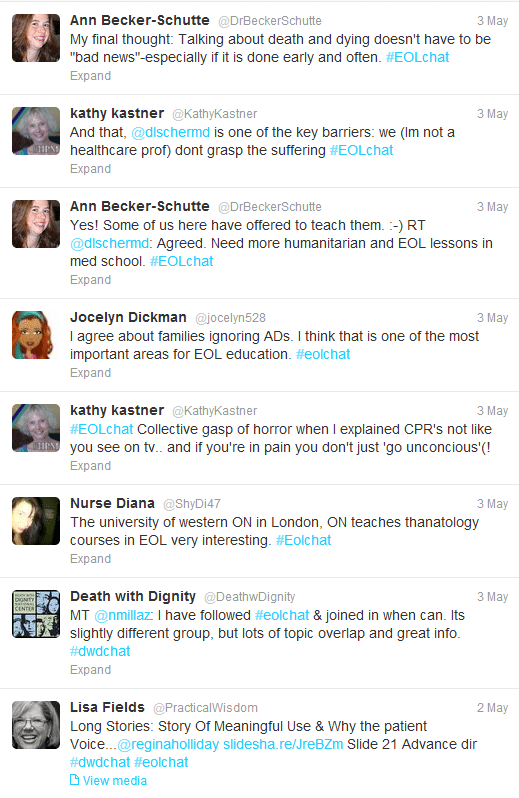
Healthcare Tweet Chats Allow You Talk About Your Specialty

healthcare tweet chat
A great example of what a healthcare tweet chat looks like.
Communication is of upmost importance to the healthcare industry. Not only is communicating with patients and colleagues significant, but also with peers in your specialty. Recently, tweet chats have emerged as a great venue to communicate with other providers within — or people generally interested in — your discipline. Tweet chats are discussions hosted through Twitter based on tweets that include hashtags, or keywords with a“#” in front of them. Placing a “#” in front of keywords allows them to be clicked on, or searched, and associated with other tweets that have that same hashtag or discuss the same thing. For example, if I’m tweeting about a new medical procedure and I want other providers who may be looking for the same information – or other people talking about that new procedure — to see my tweet, I may use the hashtag #medicalprocedure. (Just remember when adding a hashtag that you’re only allowed 140 characters!) Healthcare tweet chat topics span a wide range of specialties. From end of life care (#EOLchat), to healthcare education (#MedEd), care giving (#charechat), breast cancer (#BCSM), weight loss surgery (#wls), and postpartum depression (#PPDchat). What makes healthcare tweet chats great is that it allows for a community to come together and, at their leisure, engage in conversation about a topic important to them. Not only are tweet chats great for sharing information, but also to get the word out about your practice or your specialty. Participating in a tweet chat allows you to spread your wealth of knowledge and link to your website or promote your services in a controlled, targeted environment. View this simple healthcare tweet chat calendar to find a tweet chat for your practice to participate in. Make sure you visit our website to read more about the best ways to use Twitter as a healthcare provider, and the social media services we offer to practices, including Twitter. Or give us a call at 888-986-3638.

More patients are using social media to find health care provider information

If you think your patients aren’t using social media to search and share healthcare information online — think again.

A study released by PwC Health Industries entitled “Social Media ‘likes’ Healthcare,” states that “33% of consumers in the U.S. use social media channels to find health-related information.” And with ever-increasing ease of accessibility through mobile applications and other platforms, that number will continue to rise.

While most patients’ social media interaction involves searching and discussing symptoms, many users search social media sites to find out more information on hospitals and health care providers — either organizations they’re already aware of, or new ones. Because of their tendencies to shop around online first and seek others’ opinions and shared information, 57% of consumers said a hospital’s social media engagement affects their decision to seek treatment at that facility.

So what does that mean for hospitals and doctors today?

Historically, healthcare organizations have been late to climb on board the social media train. So, these newly published statistics should act as more motivation for health care providers to start their social media campaigns today. If you think about it in terms of the ability to reach as many patients as possible, there are currently 900 million users on Facebook and another 10.4 million on Pinterest. Those are great platforms to disperse information about your hospital or practice. It’s time to put your best foot forward out on the social landscape. By establishing a social media presence and publishing information, you are taking hold of a great opportunity to engage with people searching for information and potentially drive traffic to your website where they can attend seminars and schedule visits.

The PwC study also acknowledges: “Health organizations have an opportunity to use social media as a way to better listen, participate in discussions, and engage with consumers in ways that extend their interaction beyond a clinical encounter.” Some social media sites that may be beneficial to hospitals are Facebook, Pinterest, blogs, FourSquare, and YouTube. With these sites, you have the opportunity to answer general, non-personal questions, post news or relevant information to your patients, and provide them with some health care tidbits.

To find out how MDnetSolutions can help you with your social media strategy, contact us. Call us at 888-986-3638 or e-mail info@mdnetsolutions.com.

Why should you have a custom Facebook page?

MDnetSolutions Services Promotional Banner

By now I’m sure just about everyone is aware of the fact that it’s a good idea for your small (or large) business to be on Facebook. It’s a great vehicle for brand expansion that will give you both a larger net presence and a new channel to interact with clients, other businesses and anyone else who might stumble across your Facebook page.

However, after a while just about every business’ Facebook fan page starts to look the same. So, how do you create a Facebook experience that will stick with your users?

A custom landing page is a great way to give your brand’s Facebook page a personality beyond the standard wall, info and photo tabs. It can be as simple as an eye-catching graphic with a clear call-to-action, or as complex as a multi-page mini store.

Now that Facebook allows page administrators to implement custom pages using iframes, instead of their proprietary FBML application, just about anything can be added to your landing page to enhance a user’s experience with your brand on Facebook.

Check out a couple examples that will help get your thought process rolling:

The Threadless Facebook page is a great example of adding a new layer of interactivity. Users are given the opportunity to ‘Like’ and comment on individual designs as well as browse new additions to the Threadless catalog, which works very well in the social context of Facebook.

Taco Bell also does a great job of offering exclusive content and a more interactive experience on their custom Facebook pages. Through providing access to non fast food related content they are able to connect with a demographic who might not otherwise consider checking out the Taco Bell facebook page.

Another interesting use of Facebook comes from Motorola. They take the interactivity a step further by offering customer support through Facebook. Not only does this offer customers the chance to connect more directly with Motorola, but it also allows users to connect to each other and create a community around Motorola.

Finally, check out what we did with the Elevated Third facebook page.

A Facebook landing page isn’t a replacement for a full-featured, search engine optimized website, but it is a great opportunity to reach a new audience through a powerful and extremely popular medium.

If you’re going to put the effort into creating a unique landing page for your brand, be sure to leverage the social plugins Facebook provides to help you drive traffic there. With a variety of plugins, ranging from the simple Like Button to integrated comments and registration, there are plenty of ways to integrate your main website and Facebook landing page to be sure your brand gets the exposure it deserves.

Shopping Days Are QR Days As Scanning Triples in 2011

People are getting into the mobile scanning habit, according to the latest quarterly report from code enabler ScanBuy. The maker of the popular ScanLife platform and code program manager for Starbucks, Home Depot and Coca-Cola saw more scans in Q4 2011 than it had in all of 2009 and 2010 combined. For 2011, the ScanLife system saw a 300% increase in the number of scans. The biggest scanning days of the holiday season corresponded with the top retail shopping days, Black Friday and the two days following Christmas. The company says over 3 million more people were added to its network of ScanLife-enabled scanning apps in Q4. According to CEO Mike Wehrs, over 15 million people use the ScanLife system. “We process scans for tens of thousands of unique QR codes per month, plus over 800,000 unique UPC codes per month,” he says. Wehrs estimates that ScanBuy touches 15% to 20% of U.S. mobile users who are scanning codes. And this past season, those scans were going to consumer packaged goods. While retail had traditionally been the leading category for 2D mobile code campaigns, ScanLife saw the CPG category scale five spots to become the top source of code campaigns in the last quarter. Retail was second, entertainment third, editorial fourth and wireless fifth. Not surprisingly, given the strength of CPGs, packaging was the most popular place for codes last season. Print media — formerly the most popular type of code placement — is now #2, with the Web (#3) rising in popularity, followed by activations made on outdoor advertising and direct mail pieces. The rise of code placement on Web sites is connected to app distribution, as many of these prompts are shortcuts to app downloads. The demographics of code scanning remain decidedly male (63%). But as smartphone accessibility widens, the age range for the common scanner broadens. The 25- to-34-year-old segment is now responsible for 28% of scans, compared to 35-44 (22%) and 18-24 (22%). Only 17% of scans come from users 45 and older. The year-end bump for iPhone ownership was reflected in the ScanLife results, where scanning from the Apple phones was up 10 points to 39%, still leaving Android with a 50% share. BlackBerry is down to 6% of scans from 20% only a year ago. Wehrs says the growth in code use is coming from all sides. “The number of scans per user has been increasing, but the primary driver of the growth is the volume of new QR codes being published by marketers,” he says. In a recent survey of 100 marketers by ScanBuy, half said they were already using 2D codes and 86% said they planned to do do in the future. Want to learn more about mobile websites and QR codes?  MDNetSolutions has the answers for you.  Contact Carol O’Dell at carol@mdnetsolutions.com or 888.986.3638. Source