Topic: Activation Science & Behavioral Science

Activation science and behavioral science foundations.

Why Check-Ins Aren’t Enough

THE SCIENCE BEHIND OUR CCM MODEL

Why Monthly Check-Ins Don’t Move the Needle

CPT 99490 pays for 20 minutes of care management per month. What you do with those 20 minutes determines whether CCM is a revenue line or a cost center.

The 20-Minute Problem

Chronic Care Management reimburses $64.02 per patient per month for 20 minutes of non-face-to-face care coordination. Most programs use those 20 minutes for a scripted phone call: medication review, symptom check, care plan update, documentation. Bill the code. Move to the next patient.

The call meets compliance requirements. It generates reimbursement. And it changes almost nothing about what the patient does between visits.

A patient with poorly controlled diabetes gets asked about their blood sugar. They report it’s been high. The care manager documents the concern and recommends they follow up with their endocrinologist. The patient agrees. The call ends. The follow-up never happens because the patient can’t get an appointment for six weeks and doesn’t know how to request an earlier one.

That’s not care management. That’s documentation with a phone call attached.

What the Data Shows About Passive CCM Programs

The evidence on traditional CCM implementation is sobering. Programs that rely on scripted check-ins without barrier resolution show minimal impact on clinical outcomes. Patients stay enrolled because the calls are non-intrusive, but their conditions don’t improve because nothing about their behavior changes.

Meanwhile, the downstream costs that CCM is supposed to prevent keep accumulating. Avoidable ED visits. Preventable hospitalizations. Medication non-adherence driving acute events. Open care gaps dragging quality scores. Incomplete risk adjustment documentation leaving revenue on the table.

The reimbursement math looks positive in isolation. But when you account for the costs CCM was supposed to reduce but didn’t, the net impact is often negative.

The Activation Difference in CCM

Our CCM model uses those same 20 minutes differently. Instead of asking patients how they’re doing, our specialists identify the specific barrier preventing the patient’s next care step and resolve it during the call.

For a patient who hasn’t completed a referral: we identify whether the barrier is scheduling access, transportation, cost, or confusion about why the referral matters. Then we resolve it—scheduling the appointment, arranging transportation, connecting with financial assistance, or using motivational techniques to address ambivalence.

For a patient with medication non-adherence: we identify whether the barrier is cost, side effects, confusion about the regimen, or competing priorities. Then we take action—coordinating with the prescriber, connecting with pharmacy assistance programs, simplifying the regimen through provider communication.

Every call ends with a confirmed next step in motion. Not a recommendation. An action.

Capturing the Full Value of Every CCM Touchpoint

When CCM calls are activation-driven, every touchpoint becomes a multi-value event. The barrier resolution that improves patient outcomes simultaneously creates opportunities for complete documentation.

Risk adjustment: every clinical conversation surfaces ICD-10 codes that might go undocumented in a passive check-in. When our specialists resolve a medication barrier for a diabetic patient, they’re also ensuring the diabetes complexity is fully documented for risk adjustment purposes.

Quality measures: every completed referral, filled prescription, and scheduled screening closes a care gap. The activation that improves the patient’s health also improves your quality scores.

Additional billing: patients who are actively engaged generate more billable minutes. CPT 99439 adds $47.44 for each additional 20 minutes, billable twice per month. Patients who are being activated—not just checked on—require and benefit from more comprehensive coordination.

This is the compounding effect of activation-driven CCM. The same call that improves outcomes also improves reimbursement, risk scores, and quality measures. Nothing is left on the table.

PROVEN AT SCALE

From passive check-ins to activation-driven CCM. The operational difference is measurable.

$192K+
Annual CCM reimbursement (250 patients)
99.4%
Quality KPI pass rate
~100%
Appointment adherence
24/7
Coverage, zero gaps
  • HIPAA Compliant
  • SOC 2 Certified
  • NIST Compliant
SEE IT IN CONTEXT
This page explains why activation matters in CCM specifically. For the broader care management picture—including how CCM connects with RPM, TCM, PCM, and AWV—visit the Care Management hub.
  • Care Management Overview
    Five programs, one activation infrastructure

  • CCM Revenue Capture
    The full reimbursement math for CPT 99490 and 99439

  • Patient Follow-Through
    Why follow-through failure is the root cause of avoidable costs

Stop billing for check-ins.
Start billing for outcomes.

Schedule a consultation and we’ll show you how activation-driven CCM changes the math for your patient population.

Schedule a Consultation

Continue reading

Activation vs Compliance

THE SCIENCE BEHIND OUR CARE MANAGEMENT MODEL

Check-Ins Aren’t Enough

Most care management programs measure success by whether the call happened. We measure success by whether the patient did something different because of it. That distinction changes everything.

The Compliance Trap

The standard care management model follows a predictable pattern. Enroll the patient. Schedule a monthly call. Ask how they’re doing. Document the conversation. Bill the code. Repeat.

This model produces compliant records. It does not produce completed referrals, filled prescriptions, scheduled labs, or resolved barriers. The patient hangs up and navigates alone until the next call.

The economics look sound on paper. CPT 99490 reimburses $64.02 per patient per month for 20 minutes of chronic care management. At 250 patients, that’s $192,060 annually. But if those calls don’t change patient behavior, the downstream costs—avoidable ED visits, preventable readmissions, worsening chronic conditions—erase the reimbursement gains and then some.

Compliance without activation is an expensive phone call.

Why Monthly Check-Ins Don’t Change Behavior

Behavioral science is clear on this point: information alone does not produce action. Telling a diabetic patient to schedule their A1C does not get the A1C scheduled. Asking a heart failure patient if they’re taking their medications does not resolve the cost barrier that’s causing them to skip doses.

Monthly check-ins fail because they address awareness, not barriers. The patient already knows they should follow up with their cardiologist. They don’t because they can’t get transportation, can’t afford the copay, can’t navigate the scheduling system, or can’t reconcile conflicting instructions from three different specialists.

These are activation symptoms—the non-clinical barriers that determine whether a patient follows through on their care plan. Standard care management programs don’t assess for them, don’t document them, and don’t resolve them. They ask ‘how are you doing?’ when they should be asking ‘what’s stopping you?’

What Activation-Driven Care Management Looks Like

Our care management model is built on the Motivational Patient Guidance (MPG) framework—nine behavioral science techniques that turn every patient interaction into a barrier resolution opportunity.

Instead of scripted monthly check-ins, our specialists identify the specific barriers preventing each patient from completing their next care step. Then they resolve those barriers during the call or immediately after it.

A patient who hasn’t filled a prescription gets the cost barrier identified and addressed—whether that means connecting them with a patient assistance program, coordinating with their prescriber for a generic alternative, or arranging pharmacy delivery. A patient who missed a follow-up gets the scheduling barrier resolved—transportation arranged, appointment confirmed, pre-visit instructions delivered.

Every touchpoint simultaneously captures billing documentation, closes quality gaps, and updates risk adjustment data. The clinical work and the administrative work happen in the same interaction. Nothing is left on the table.

Connected Programs, Not Siloed Phone Calls

The activation model becomes exponentially more powerful when it spans all five CMS care management programs. A patient who discharges from the hospital enters TCM. Our team reaches them within 48 hours, resolves medication confusion, confirms follow-up appointments, and addresses discharge barriers.

When the 30-day TCM window closes, they transition seamlessly to CCM. Their RPM data informs every CCM call—when readings spike, our team contacts the patient before it becomes an ED visit. Their annual wellness visit captures updated ICD-10 codes that strengthen risk adjustment scores.

One patient. One relationship. Five revenue streams. Every touchpoint building on the last.

This is what separates a care management operation optimized for compliance from one optimized for activation. The billing codes are the same. The documentation is the same. The outcomes are not.

The Economic Difference

When care management is built for activation, the financial model compounds. Reimbursement capture improves because patients stay enrolled—they see value in the relationship, not just a monthly phone call they tolerate. Quality measures close because barriers get resolved, not just identified. Risk adjustment scores improve because every interaction documents complete clinical data.

And the downstream savings multiply: fewer avoidable ED visits, fewer preventable readmissions, fewer patients lost to follow-up. The care management program stops being a cost center that generates modest reimbursement and becomes the infrastructure that holds your entire value-based care strategy together.

PROVEN AT SCALE
From compliance-focused check-ins to activation-driven care management. Organizations using our model see measurable differences.
~100%
Appointment adherence
99.4%
Quality KPI pass rate
35%
Fewer readmissions
31%
Higher patient satisfaction

HIPAA Compliant · SOC 2 Certified · NIST Compliant

SEE IT IN CONTEXT

This page explains the behavioral science that differentiates our care management model. For the full operational picture—including how we deliver all five CMS programs through a single team—visit the main Care Management page.

  • Care Management Overview
    Five programs, one activation infrastructure

  • Chronic Care Management
    Deep dive into CCM operations and reimbursement

  • Patient Activation Approach
    The complete Motivational Patient Guidance framework

See what activation-driven care management produces

Schedule a consultation and see how we eliminate abandoned calls and protect the revenue your phones are losing today.

Schedule a Consultation

Continue reading

Patient Follow-Through in Chronic Care Management

CHRONIC CARE MANAGEMENT

Your Chronic Patients Know What To Do. They’re Not Doing It.

Medications go unfilled. Specialist referrals go unscheduled. Lab work gets skipped. Follow up visits don’t happen. The gap between what patients are told to do and what they actually complete is where chronic disease management breaks down.
THE CHALLENGE

Follow Through Is Where Chronic Care Management Breaks Down

Chronic disease doesn’t resolve with a single intervention. It requires sustained follow through: filled prescriptions, completed labs, kept appointments, dietary changes, and ongoing monitoring. Most patients with multiple chronic conditions know what they should be doing. They’re not doing it.

This isn’t a knowledge problem. Patients aren’t skipping their A1C because they don’t know they need one. They’re skipping it because the lab requires a separate appointment they can’t schedule during work hours, or because they’re confused about fasting requirements, or because they already feel overwhelmed managing three other conditions and this one didn’t feel urgent enough today.

When patients don’t follow through, their conditions deteriorate predictably. Blood sugar climbs. Blood pressure stays uncontrolled. Preventive screenings get missed. And the healthcare system absorbs the cost of the downstream events: ED visits, hospitalizations, readmissions, and complications that could have been prevented with consistent activation.

ROOT CAUSE

The Care Management Model Stops at Advice

The follow through failure isn’t about patient motivation. It’s about a care management model that stops at advice.

  • Traditional CCM checks on patients. It doesn’t move them.

    Most CCM programs follow a documentation driven script: ask how the patient is doing, note any changes, update the care plan, bill the code. That conversation produces a compliant record. It doesn’t produce a completed referral, a filled prescription, or a scheduled lab appointment. The call ends. The patient is on their own. And the same barriers that prevented follow through last month are still there.

  • Every chronic patient carries activation barriers alongside their diagnoses.

    Cost concerns. Transportation gaps. Scheduling confusion. Low health literacy. Competing priorities. Lack of confidence. These aren’t clinical symptoms. They’re activation symptoms. And no clinical protocol addresses them. A patient who can’t afford their copay doesn’t need better clinical advice. They need someone to connect them with financial assistance. A patient who doesn’t understand what their endocrinologist does doesn’t need another referral letter. They need someone to explain the visit and book it while they’re still on the phone.

  • The compounding cost of inaction is enormous.

    A patient with uncontrolled diabetes who misses quarterly A1C testing for a year doesn’t just have a quality gap. They have a meaningfully higher risk of diabetic ketoacidosis, neuropathy, and cardiovascular events. Each of those outcomes costs tens to hundreds of thousands of dollars and creates cascading complications. The monthly cost of a CCM touchpoint that actually activates that patient is trivial compared to a single avoidable hospitalization.

  • Patients who don’t follow through also leave.

    When chronic patients feel unsupported, they look for care elsewhere. They go to the urgent care down the street. They switch to a competitor’s primary care practice that called them proactively. Patient leakage among your highest acuity, highest value population is the most expensive kind.

OUR APPROACH

Activation, Not Compliance

We built our CCM model around activation, not compliance. Every call is structured to identify what’s keeping the patient from following through and then resolve it before the call ends.
  • Activation psychology at every touchpoint

    Our specialists are trained in behavioral science techniques that identify and address the non clinical barriers driving non adherence. Cost fear, scheduling confusion, low confidence, access frustration. Each one has a structured resolution pathway.

  • One call resolution whenever possible

    When a patient needs a lab scheduled, we schedule it during the call. When they need a prescription refilled, we initiate the process. When they need a specialist referral explained, we explain it and book the appointment. The patient hangs up with the action completed, not with instructions to complete it later.

  • Closed loop follow up

    We don’t assume the action happened because we scheduled it. We confirm completion. If the patient missed their appointment, we call back, identify what went wrong, and reschedule. The loop doesn’t close until the action is done.

  • Condition specific protocols that go beyond clinical documentation

    Our workflows are designed for the full spectrum of chronic conditions. Diabetes, COPD, heart failure, hypertension, and complex comorbidities. Each protocol includes activation pathways for the most common barriers that condition population faces.

RELATED CHALLENGES
  • Quality gaps are the measurable evidence that follow through is failing

    The same patients who aren’t following through are the ones with open quality measures.

    Go Deeper

  • Staff bandwidth means nobody has time for the kind of outreach that actually changes behavior

    Your team is too stretched to deliver the consistent, activation driven outreach chronic patients need.

    Go Deeper

  • Revenue is going uncaptured because the program that should drive activation isn’t running

    Every month without effective CCM is a month of missed reimbursement and worsening patient outcomes.

    Go Deeper

PROVEN AT SCALE

From documented conversations to completed actions

We turn chronic care calls into measurable outcomes by resolving the barriers that keep patients from following through.
~100%
Appointment adherence
35%
Fewer readmissions
31%
Higher patient satisfaction
99.4%
Quality KPI pass rate

Turn chronic care calls into completed next steps

See how activation driven CCM transforms patient outreach from documentation exercise to measurable health outcomes.

Schedule a Consultation

Back to Chronic Care Management Overview

Continue reading

The Coverage Certainty Effect

INSURANCE VERIFICATION

The Coverage Certainty Effect: Why Verification Changes Whether Patients Show Up

Your team already knows verification matters for revenue. Here’s what most organizations miss: it matters just as much for whether patients follow through on care.
THE PROBLEM YOU’RE SOLVING FOR TODAY

Verification Is Treated as a Back-Office Function. The Patient Pays the Price.

Insurance verification exists to protect your revenue cycle. Without confirmed coverage, claims get denied, reimbursements stall, and your finance team spends weeks chasing corrections. Every healthcare leader understands this math.

So most organizations treat verification as a back-office function. Check the box. Confirm eligibility. Move on.

The problem isn’t that you’re doing verification wrong. It’s that you’re underestimating what verification does to the patient.

WHAT WE SEE THAT CHANGES THE CONVERSATION

Patients Who Don’t Understand Their Coverage Don’t Show Up

Not always. Not every time. But at rates that compound into serious operational and clinical cost. And almost no one connects the dots between verification and patient follow-through because they sit in different departments, measured by different KPIs, managed by different leaders.

Financial uncertainty creates decision paralysis. When a patient schedules a procedure but doesn’t know what they’ll owe, that uncertainty sits in the back of their mind. They don’t call to ask. They don’t look it up. They just… don’t go. Research consistently shows that ambiguity around out-of-pocket costs is one of the top reasons patients delay or cancel elective procedures and specialist visits.

Delayed verification compounds the anxiety. The longer the gap between scheduling and coverage confirmation, the more time patients have to talk themselves out of it. Every day without clarity is a day the patient’s commitment weakens.

No-shows from coverage confusion look identical to no-shows from apathy. Your scheduling team sees a cancelled appointment and marks it as a no-show. Your verification team sees a completed eligibility check and marks it as done. Neither team sees that the patient cancelled because they couldn’t get a straight answer about what their plan would cover. The data never connects.

The downstream cost goes far beyond one missed appointment. A patient who cancels a specialist referral because of coverage confusion doesn’t just miss that visit. They miss the diagnosis. They miss the early intervention. They show up months later in the ED with a condition that could have been caught and managed at a fraction of the cost. For organizations measured on readmission rates, quality scores, and total cost of care, this isn’t a scheduling inconvenience. It’s a clinical and financial failure that started with a verification process that checked the box but never activated the patient.

HOW WE SOLVE IT

Verification as an Activation Moment, Not an Administrative Task

  • Our specialists are trained to do more than confirm eligibility. They verify insurance type, outline surgical and procedural benefits, and describe primary care physician referral requirements. But the difference is in how and when that information reaches the patient.

  • Flexible timing that matches your workflow

    Some organizations need verification completed before scheduling so patients have full clarity at the point of commitment. Others prefer verification after scheduling so the appointment is locked in and coverage details follow quickly. We operate on your protocols, not ours — because the right timing depends on your patient population, specialty mix, and scheduling workflows.

  • Coverage clarity removes hidden barriers

    When a patient hears “your coverage is confirmed and here’s what to expect,” that clarity removes one of the most common hidden barriers to follow-through. The verification call becomes the moment the patient shifts from “I have an appointment” to “I’m going to that appointment.”

  • Cognitive Clarity from our MPG framework

    This is Cognitive Clarity and Effort Minimization from our Motivational Patient Guidance framework, applied to a process most organizations treat as purely operational. We minimize the cognitive load of financial uncertainty and make the next step feel easier, not harder.

  • Pre-auth handled so your staff can focus

    Our team handles pre-authorization, pre-certification, and pre-determination so your staff can focus on the patients in front of them. But the real value isn’t just the time we save your team — it’s the patients who show up because someone removed the uncertainty before it became a reason to cancel.

IF YOU’RE SEEING THIS, YOU’RE LIKELY FACING THESE TOO

Related Challenges

  • Scheduling friction costs you more than no-shows

    Coverage confusion is just one barrier. Scheduling friction compounds the problem and drives patients to competitors.

    Nudge theory in patient scheduling

  • After-hours coverage gaps leave patients without answers

    Patients who can’t get coverage clarity during business hours don’t call back. They disengage.

    Why timing changes outcomes

  • Verification bottlenecks are delaying care before it begins

    The same verification gaps that confuse patients are also disrupting your schedule and surgical utilization.

    When verification delays become care delays

PROVEN AT SCALE

From coverage confusion to patient certainty

~100%
Appointment adherence rates
200+
Partner clients
HIPAA
Compliant · SOC 2 Certified

Stop treating verification as a checkbox.

If your verification process confirms eligibility but doesn’t give the patient clarity and confidence, you’re leaving follow-through on the table. Let’s talk about what verification could actually do for your patient follow-through.

Schedule a Consultation

Continue reading

Decision Fatigue and Choice Architecture

ROOT CAUSE

“When Would You Like to Come In?” Is the Most Expensive Question in Healthcare Scheduling

It sounds helpful. It sounds patient-centered. And it’s the single most common reason patients book tentatively, cancel easily, and no-show without guilt. Open-ended scheduling creates the illusion of flexibility while destroying the psychological commitment that makes a patient actually show up.
THE HIDDEN COST

Your Scheduling Script Is Designed for Politeness, Not for Commitment

Most scheduling interactions follow the same pattern. The patient calls. The scheduler asks what they need. The patient explains. The scheduler asks when they’d like to come in. The patient hesitates, picks a date, and the call ends. Both parties feel the interaction went well. The appointment is on the books.

Three weeks later, the slot is empty.

The problem isn’t the scheduler and it isn’t the patient. The problem is the architecture of the choice itself. Behavioral science has demonstrated this consistently: when people face open-ended choices with too many options, they make weaker decisions. And weak decisions are easy to reverse.

This is decision fatigue, and it operates in every scheduling call your team handles.

WHAT YOU’RE NOT SEEING

The First 30 Seconds of the Call Determine Whether the Patient Shows Up in Three Weeks

There are three mechanisms at work, and none of them appear in your scheduling metrics.

Too many options create paralysis, then default to the easiest choice. When a scheduler opens the calendar and says “we have Tuesday at 10, Wednesday at 2, Thursday at 9, or the following Monday at 11,” the patient’s brain isn’t evaluating options. It’s overloaded. They pick something that sounds okay. “Tuesday, I guess.” That “I guess” is the tell. The patient made a selection, not a commitment. Selections get canceled. Commitments get kept.

Open-ended framing transfers ownership to the patient prematurely. “When works for you?” puts the entire cognitive burden on the patient. They have to mentally review their work schedule, their childcare, their commute, their other appointments. They have to weigh all of that against a medical appointment they may not fully understand the urgency of. That’s a heavy lift for a phone call they expected to take two minutes. Many patients pick a date just to end the interaction. That’s compliance, not commitment.

No micro-commitment anchors the decision. In behavioral science, a micro-commitment is a small, concrete action that builds toward a larger one. Effective scheduling creates these naturally. “I have two spots that work well for what Dr. Torres needs to see. Tuesday morning or Thursday afternoon. Which of those two fits your week better?” The patient chooses between two options. Then: “Perfect. I’m locking that in for you. You’ll get a confirmation text in the next hour. If anything changes, call us at least 24 hours ahead so we can give that spot to another patient.” That last sentence creates social accountability. The patient now feels that the slot belongs to someone, and canceling means taking it from them.

This isn’t manipulation. It’s the same behavioral architecture that makes restaurant reservations, airline bookings, and hotel confirmations work. Healthcare scheduling just hasn’t caught up.

The data you can’t see. Your scheduling system records “appointment booked.” It doesn’t record how the appointment was booked, how many options were offered, whether the patient hesitated, or how strongly they committed. So when that appointment becomes a no-show, your system attributes it to the patient. It should attribute it to the interaction.

THE COST OF WAITING

Every Day Your Team Uses the Old Script, You’re Manufacturing No-Shows

Your no-show rate has a floor and this is why. You’ve invested in reminders, waitlists, and overbooking. You’ve pushed the no-show rate down from where it was. But it won’t go lower. That floor exists because the appointments were never psychologically anchored. Reminders can’t fix what the booking interaction didn’t build.

The problem scales with your growth. As you add providers, locations, and specialties, scheduling complexity increases. More options per call means more decision fatigue per patient. Your growing organization is inadvertently making the problem worse because every new provider slot is another option in an already overloaded choice set.

Staff training doesn’t solve it. You can train schedulers to be faster and friendlier. But unless the training includes behavioral framing techniques, the fundamental architecture of the interaction stays the same. Friendlier open-ended questions still produce weak commitments.

The compounding effect on patient retention. A patient who no-shows once is statistically more likely to no-show again. Each weak commitment reinforces a pattern of tentative engagement with your system. Over time, these patients disengage entirely. They don’t leave dramatically. They just stop scheduling. And your retention data shows a gradual decline that’s hard to attribute to any single cause.

HOW WE SOLVE IT

Limited Options. Built-In Commitment. Kept Appointments.

Our agents are trained in choice architecture. They present limited, curated options rather than open calendars. They use behavioral framing to build micro-commitments at the moment of booking. And they create social accountability through structured confirmation language. The result is appointments that patients chose deliberately, not tentatively.

IF YOU’RE SEEING THIS, YOU’RE LIKELY FACING THESE TOO

If decision fatigue is driving your no-show rate, you’re likely also facing:

  • Patient motivation fades between booking and the appointment

    Even a well-booked appointment loses power over time. Decision fatigue is the booking problem. Motivation decay is the interval problem. They work together.

    Why reminders aren’t enough

  • No-shows are draining revenue and you’ve hit a floor on reducing them

    Standard reminder systems reduce no-shows from forgetfulness. They don’t reduce no-shows from weak commitment. That’s why your rate plateaus.

    No-show root causes

  • Scheduling failures leak revenue far beyond the empty slot

    A no-show caused by decision fatigue isn’t just one lost visit. It’s the downstream chain that evaporates with it.

    Quantify the downstream revenue impact

Continue reading

Motivation Decay and Appointment Reminders

ROOT CAUSE

The Patient Who Books Today Won’t Feel the Same Urgency in Two Weeks

They called because something hurt, because their doctor said to follow up, because the test result scared them. In that moment, they would have come in the same day if you had an opening. Instead, they booked for two weeks out. Every day between now and then, the urgency that drove the call is fading. By the time the reminder text arrives 24 hours before the appointment, the patient has to decide all over again whether showing up is worth the effort. That’s not a reminder problem. That’s a motivation problem.
THE HIDDEN COST

Your Reminder System Confirms the Date. It Doesn’t Sustain the Reason.

Automated reminders are now standard in healthcare scheduling. Text messages, emails, phone calls, patient portal notifications. Most practices send at least two reminders before an appointment. Some send three.

And they work for a specific subset of no-shows: patients who genuinely forgot. That subset is real but shrinking as reminder technology becomes ubiquitous. The patients who still no-show in a world of automated reminders didn’t forget. They deprioritized.

A text that says “Reminder: You have an appointment with Dr. Chen on Thursday at 2:00 PM. Reply C to confirm or X to cancel” does exactly one thing. It confirms the logistics. It does not address whether the patient still feels motivated to come.

The patient sees the text. They think about the drive, the copay, the time off work, the wait in the lobby. They weigh that against how they feel right now, which is probably fine because the acute symptom that prompted the call has faded. And they cancel. Or they just don’t show.

Your reminder did its job perfectly. It reminded the patient of the appointment. The patient remembered. And they chose not to come. The reminder didn’t fail. It was never designed to do what the moment required.

WHAT YOU’RE NOT SEEING

Motivation Is a Perishable Resource, and Your System Does Nothing to Preserve It

Behavioral science has a name for this: temporal discounting. The further an event is from the present moment, the less weight it carries in decision-making. A medical appointment three weeks away feels abstract. The inconvenience of attending it feels concrete. Concrete beats abstract almost every time.

The motivation curve drops fastest in the first 48 hours. The patient calls on Monday feeling anxious about symptoms. They book for two weeks from Thursday. By Wednesday, the anxiety has subsided. The symptom improved or they got used to it. The emotional intensity that drove the call is gone, and the appointment exists only as a calendar entry with no emotional charge behind it.

Standard reminders arrive too late in the curve. A 48-hour reminder and a 24-hour reminder arrive when motivation is already at its lowest point. They’re asking the patient to recommit to something they committed to under different emotional conditions. It’s the equivalent of asking someone to honor a gym membership they signed up for in January when it’s now February and they feel fine on the couch.

No reinforcement bridges the gap. Between the booking call and the first reminder, most patients hear nothing from your system. That silence communicates something: this appointment isn’t important enough for us to prepare you for. Compare that to how other industries handle commitments: airlines send booking confirmations, trip preparation emails, check-in prompts, and gate updates. Hotels send confirmation, local recommendations, early check-in offers. Every touchpoint sustains engagement. Healthcare sends a booking confirmation and then goes silent until the reminder.

The patient’s “why” gets lost. At the moment of booking, the patient had a reason. Chest pain. A suspicious symptom. A doctor’s recommendation. That reason fades unless someone reinforces it. A motivational touchpoint three days after booking that says “Here’s what Dr. Chen will evaluate at your visit and why it matters for your health goals” sustains the reason. A logistics reminder two days before the appointment does not.

THE COST OF WAITING

The Gap Between Booking and Appointment Is Where Patient Loyalty Erodes

Late cancellations can’t be backfilled. When a patient cancels 24 hours or less before their appointment, that slot is almost certainly lost. Waitlists rarely fill same-day slots consistently. The revenue is gone. And unlike a no-show, a late cancellation feels polite. The patient thinks they did the right thing by calling. Your system recorded a cancellation, not a failure. But the impact is identical.

Patients who cancel once are harder to reschedule. The patient who canceled because their motivation decayed doesn’t feel urgency to rebook. They’ll get to it eventually. Eventually becomes never for a significant percentage. Your rescheduling outreach reaches them when they’re in the same low-motivation state that caused the cancellation. The cycle repeats.

Clinical outcomes deteriorate in the gap. The patient who was referred for a follow-up after abnormal bloodwork and cancels at two weeks is now four weeks without clinical evaluation. If they cancel again, it’s six weeks. The condition that prompted the referral doesn’t pause while the patient procrastinates. Every week of delay is a week of unmonitored risk.

Your investment in reminders has peaked. More reminders, more channels, more automation. The marginal return on reminder technology is declining because you’ve already captured the forgetfulness segment. The segment that remains, the patients who deprioritize rather than forget, requires a different intervention entirely. More of the same won’t move the number.

HOW WE SOLVE IT

Reminders Confirm the Date. Activation Sustains the Reason.

We build timed outreach sequences between booking and appointment that reinforce why the visit matters, surface and resolve barriers before they become cancellations, and sustain the motivational momentum that prompted the original call. This isn’t a reminder strategy. It’s a motivation strategy. The reminder is just the last touchpoint in a sequence designed to keep the appointment alive in the patient’s mind.

IF YOU’RE SEEING THIS, YOU’RE LIKELY FACING THESE TOO

If motivation decay is driving cancellations, you’re likely also facing:

  • How the appointment was booked in the first place matters more than the reminder

    Weakly committed appointments are the ones most vulnerable to motivation decay. If decision fatigue produced a tentative booking, no amount of reminders will save it.

    Decision fatigue and choice architecture

  • Your no-show rate has plateaued despite investing in reminders

    The floor on your no-show rate exists because the segment you haven’t addressed isn’t forgetting. They’re deprioritizing. Different problem. Different solution.

    No-show root causes

  • Every cancellation leaks revenue beyond the empty slot

    The follow-up that doesn’t happen triggers a cascade: the referral that won’t be made, the imaging that won’t be ordered, the procedure that won’t be scheduled.

    Quantify the downstream revenue impact

Continue reading

Activation Science in Patient Care Coordination

PATIENT CARE COORDINATION

Most Coordination Gets the Appointment Booked. Ours Gets the Patient There.

Booking an appointment isn’t the hard part. Getting the patient to show up, prepared, on time, with the right paperwork, having followed the pre procedure instructions, is where most coordination breaks down. The reason isn’t logistical. It’s behavioral.
THE GAP

The Gap Between Scheduled and Completed

Patients don’t skip appointments because they forgot the date. They skip because they’re anxious about the procedure, confused about the prep, overwhelmed by the steps, or uncertain whether it’s worth the effort.

Traditional care coordination treats every interaction as an administrative transaction. Call the patient. Confirm the appointment. Read the instructions. Check the box. That approach works for the patients who were going to follow through anyway. It fails for the ones who need something more.

FOUNDATIONAL MOTIVATION

Motivational Patient Guidance in Coordination

Motivational interviewing and empathetic inquiry uncover what drives each patient. A scheduling call becomes a conversation about what the patient wants to achieve, not just what time slot is open.

Contrast and framing helps patients see the difference between acting now and waiting.

Social proof normalizes the recommended action by connecting it to what similar patients have done. The result: patients who schedule because they want to, not because they were told to.

COGNITIVE CONGRUENCE

Compliant Pathways That Make Sense to Patients

Commitment and consistency principles break the care pathway into small, manageable agreements. Each call builds on the last. Each step feels like the obvious next one, not a burden.

The Power of “Why” ensures patients understand the purpose behind each instruction, not just the instruction itself.

Balanced authority positions the coordinator as a guide, not a gatekeeper. Patients cooperate because the path makes sense to them. The result: fewer no shows, better pre procedure compliance, fewer day of cancellations.

RELATIONAL ACCELERATION

Proactive Autonomy and Trust

Relational communication builds real rapport across multiple touchpoints. Coordinators remember details. They follow up proactively. They make the patient feel known.

Ease and effort minimization means the coordinator removes friction before the patient encounters it: verifying insurance in advance, confirming transportation, calling the pharmacy.

Reciprocity creates a dynamic where the patient feels supported, which motivates follow through without pressure. The result: patients who don’t just show up for the next appointment, but stay activated across their entire care journey.

HOW WE SOLVE IT

Coordination That Activates, Not Just Administrates

Most vendors measure coordination success by calls completed and appointments scheduled. We measure it by appointments kept, instructions followed, and patients activated to take the next right step. That’s the difference between a call center and an activation engine. The logistics look the same from the outside. The outcomes don’t.

IF YOU’RE SEEING THIS, YOU’RE LIKELY FACING THESE TOO

Back to Patient Care Coordination

  • Patient Care Coordination

    See the full coordination solution and how it integrates with your workflows.

    Back to Patient Care Coordination

  • Explore Our Full Approach

    Learn about the Motivational Patient Guidance framework that powers every service we deliver.

    Our Approach

PROVEN AT SCALE
~100%
Appointment adherence
99.4%
Quality KPI pass rate

See coordination that activates

Schedule a consultation and see the difference between transactional coordination and activation powered coordination.

Schedule a Consultation

Continue reading

Barrier Resolution

The Root Cause

Non-Clinical Barriers Are Where Care Falls Apart

Research consistently shows that social determinants of health — transportation, financial stress, housing instability, social isolation — account for up to 80% of health outcomes. Yet most clinical touchpoints are designed to address only the 20% that’s clinical.

When a patient says “I’ll try to make it,” that’s not agreement — it’s a warning sign. Something is in the way. Our Stressor Inventory process is designed to find it, name it, and remove it before it becomes a missed appointment.

This is not social work. This is activation science. The act of resolving a barrier — especially an unexpected one — triggers reciprocity in the patient: they feel cared for, and they follow through.

40%+

of referred patients never complete their next step — not because of clinical disagreement, but because of logistical and social barriers that were never addressed.

80%

of health outcomes are determined by social factors — transportation, financial stress, housing — not clinical care quality.
What We Find

The Six Categories of Patient Barriers

  • Transportation

    • No reliable car
    • Bus routes don’t reach the clinic
    • Can’t take time off work to drive
  • Financial Stress

    • Can’t afford copay
    • Worried about balance billing
    • Insurance confusion
  • Fear & Anxiety

    • Afraid of a bad diagnosis
    • Negative past experience
    • Health anxiety
  • Confusion & Complexity

    • Didn’t understand the referral
    • Overwhelmed by next steps
    • Language barrier
  • Scheduling & Logistics

    • Couldn’t find an open slot
    • No childcare
    • Competing appointments
  • Belief & Motivation

    • ‘It’ll go away on its own’
    • Distrust of the system
    • Low health literacy

The Process

The Stressor Inventory

A four-step framework for surfacing, naming, and resolving barriers before they become missed appointments.
  • 01

    Open the Conversation

    Rather than assuming compliance, our guides ask: ‘Is there anything that might make it difficult to keep this appointment?’ This single question surfaces barriers that would otherwise remain invisible.

  • 02

    Inventory the Stressors

    Using our structured Stressor Inventory framework, guides systematically explore known barrier categories — transportation, financial, logistical, emotional — without making the patient feel interrogated.

  • 03

    Mobilize Resources

    For every barrier surfaced, our guides have access to a resource library: transportation assistance programs, financial counselors, interpreter services, patient navigators. The guide becomes a problem-solver, not just a message relay.

  • 04

    Confirm Resolution

    Barrier resolution isn’t complete until the patient confirms the blocker is removed. We follow up to confirm transportation was arranged, the financial question was answered, or the confusion was resolved.

Continue reading

No-Show Prevention for Physician Practices

No-Show Prevention for Practices

Your Patients Booked.
They Just Didn’t Show Up.

No-shows aren’t a patient behavior problem. They’re an activation gap. We close it with behavioral science techniques applied from the moment of booking through the day of the appointment.

The Challenge

The No-Show Problem for Practices

You booked the patient. You sent the reminder. They still didn’t show. The problem isn’t the reminder — it’s everything that happened (or didn’t) between booking and appointment day.

Your no-show rate isn’t a patient problem — it’s a process problem

Patients don’t intentionally miss appointments. They forget, they get anxious, they encounter a barrier, or the scheduling interaction didn’t build enough commitment. The fix isn’t penalties. It’s activation.

No-shows & cancellations

Reminders alone don’t change behavior

Text reminders confirm logistics. They don’t address the psychological barriers that cause no-shows: anxiety about the visit, uncertainty about cost, or the gradual erosion of motivation between booking and appointment day.

Why reminders aren’t enough

Every empty chair costs far more than one missed visit

A no-show doesn’t just cost the visit fee. It costs provider time, staff preparation, and the downstream revenue from labs, imaging, procedures, and follow-ups that would have followed.

Downstream revenue impact

Root Cause

As Healthcare Experts, We See the Deeper Problem

No-shows aren’t random. They follow predictable patterns driven by how the appointment was booked, what barriers exist, and whether commitment was built during the interaction.
  • The way the appointment was booked determines whether the patient shows up

    COMMITMENT GAP

    Transactional scheduling (‘Does Tuesday work?’) creates weak commitment. Activation-driven scheduling builds psychological ownership of the appointment through guided choice, verbal confirmation, and barrier pre-resolution.

    Choice architecture & booking rates

  • You don’t know why patients no-show because nobody asked

    BARRIER BLINDNESS

    Transportation, childcare, cost anxiety, fear of diagnosis — these barriers exist at the time of booking but are never surfaced. A 30-second barrier screen during scheduling can prevent a no-show days later.
  • Patient intent peaks at booking and declines every day until the appointment

    MOTIVATION DECAY

    The further the appointment is from the moment of motivation, the higher the no-show risk. Strategic touchpoints between booking and visit day maintain commitment without becoming annoying.

    Motivation decay research

  • No-show rates above 10% create a compounding revenue problem

    REVENUE COMPOUNDING

    At a 15% no-show rate across a five-provider practice, you’re losing the equivalent of nearly one full provider’s productivity every week. The revenue loss extends far beyond the missed visit fee.
Our Approach

No-Show Prevention Through Activation

We don’t just remind patients. We activate them — building commitment at booking, resolving barriers proactively, and maintaining motivation through the day of the appointment.
  • Activation at the point of scheduling

    Our agents use behavioral science techniques during the booking call to build commitment: guided choice, verbal commitment, and barrier pre-resolution. The no-show prevention starts at booking, not the day before.

  • Barrier screening during every interaction

    Transportation? Cost concerns? Anxiety about the visit? We surface barriers at booking and resolve them before they become no-shows.

  • Strategic inter-appointment touchpoints

    Not just reminders. Purposeful check-ins that maintain motivation, confirm logistics, and re-activate commitment at the moments that matter most.

  • Real-time backfill from waitlists

    When cancellations do happen, we fill the gap immediately from your waitlist. No empty chairs, no lost revenue.

  • Data-driven no-show risk profiling

    We identify which patients are highest-risk for no-shows based on booking patterns, barrier profiles, and engagement signals — then apply targeted activation.

PROVEN AT SCALE

From No-Shows to 98% Adherence

Activation-driven scheduling replaces reminder-based approaches with behavioral science that builds commitment from the first interaction.
98%
Appointment adherence
30%
New patient adherence increase
9
Behavioral science techniques
200+
Partner clients

Ready to solve your no-show problem?

Schedule a consultation and see how activation-driven scheduling can bring your adherence rates to where they should be.

Schedule a Consultation

Continue reading

Anxiety-Driven Utilization in After-Hours Support

ROOT CAUSE

The Parent Calling at 10 PM Isn’t Asking a Clinical Question. They’re Asking ‘Should I Be Scared?’

The child’s fever is 101. Clinically, that’s manageable at home with standard interventions. But the parent isn’t thinking clinically. They’re thinking about the article they read last month about meningitis. They’re thinking about the time their neighbor’s child was hospitalized. They’re thinking about the fact that it’s nighttime, the pediatrician’s office is closed, and no one can tell them whether this is normal or dangerous. The clinical answer takes 30 seconds. The emotional answer takes five minutes. Standard answering services provide neither.
THE HIDDEN COST

After-Hours Calls Happen at the Intersection of Medical Uncertainty and Maximum Anxiety

During business hours, a patient with a concern can call the office, speak to a nurse, and be reassured or directed within minutes. The process is fast because the clinical infrastructure is active and the patient’s anxiety is moderated by the knowledge that help is immediately available.

After hours, every variable reverses. The clinical infrastructure goes quiet. The patient’s anxiety amplifies because they’re alone, it’s dark, the concern feels more serious at night, and the one system they trust to help them is unreachable. The same symptom that would generate a calm phone call at 2 PM generates a panicked ER visit at 10 PM.

This isn’t irrational. It’s predictable. Behavioral science has documented the phenomenon extensively. Uncertainty plus limited options plus heightened emotional state produces conservative, high-cost decisions. The patient defaults to the safest-feeling option, which is the emergency department, not because it’s the right level of care but because it’s the only level of care that’s open and visible.

WHAT YOU’RE NOT SEEING

Answering the Clinical Question Without Addressing the Anxiety Is Why Answering Services Fail

A standard answering service takes a message. The patient needs a conversation. The service asks the patient to describe their symptoms. The patient does. The service either pages the on-call provider or tells the patient someone will call back. The patient is left waiting with the same anxiety they had before the call, now compounded by the uncertainty of when someone will respond. For many patients, the ER becomes the answer while they’re still waiting for the callback.

Protocols address symptoms. Activation addresses the person behind the symptoms. A triage protocol can determine that a 101-degree fever in a 3-year-old with no other concerning symptoms warrants home care with a next-day follow-up. That’s the clinical answer. But delivering that answer effectively at 10 PM to a frightened parent requires a different skill. It requires empathy that validates the parent’s concern without dismissing it. It requires confidence that gives the parent permission to trust the guidance. It requires a clear, actionable plan that replaces anxiety with a defined next step. Protocol compliance delivers the first. Activation training delivers all three.

The patient’s decision happens in the emotional gap between the symptom and the guidance. If a trained nurse answers within 30 seconds, listens thoroughly, and delivers a clear recommendation with warmth and authority, the patient’s anxiety drops. They follow the guidance. They stay home. But if the phone rings six times and goes to voicemail, the anxiety persists. If the callback takes 20 minutes, the anxiety has built. If the person who calls back sounds rushed or uncertain, the patient’s confidence drops further. The ER visit happens not because the clinical advice was wrong but because the emotional need was never met.

Nighttime amplifies every negative signal. Research on health-related decision-making consistently shows that fear responses are stronger at night. Pain feels worse. Symptoms feel more threatening. Uncertainty feels more dangerous. The same patient who would calmly call a nurse line at 2 PM and accept “monitor and follow up tomorrow” will reject that same advice at 11 PM because the emotional context has changed. After-hours clinical coverage that doesn’t account for this amplification effect will consistently under-perform on ER diversion.

Parents and caregivers have a lower threshold and higher stakes. When the patient is a child, an elderly parent, or a dependent with cognitive limitations, the caller isn’t making decisions about their own body. They’re making decisions about someone they feel responsible for. The threshold for “I need to do something” drops dramatically. A parent will tolerate uncertainty about their own symptoms in a way they will not tolerate uncertainty about their child’s. Effective after-hours triage for these callers requires not just clinical competence but the ability to transfer confidence. The caller needs to hang up believing they are doing the right thing by staying home. That belief has to be stronger than their fear.

THE COST OF WAITING

Anxiety-Driven ER Visits Are the Most Preventable and the Most Expensive After-Hours Outcome

ach avoidable visit costs 10 to 30 times what the triage call would have cost. A triage call that takes 8 minutes and reassures a parent costs your system a fraction of the $1,500 to $3,000 that the ER visit would have generated. Across hundreds of after-hours calls per month, the savings from effective anxiety management are substantial and measurable.

The patient experience damage is permanent per incident. A patient who went to the ER because they couldn’t reach your system doesn’t forget. They now associate after-hours care with your organization’s absence. That association persists even after you implement better coverage. First impressions of after-hours accessibility are sticky and negative experiences are shared.

Clinical resources are misdirected. Every non-urgent patient in your ED consumes triage time, bed space, nursing attention, and physician minutes that could be directed toward patients with genuine emergencies. Anxiety-driven after-hours visits don’t just cost money. They degrade the quality of care for the patients who actually need emergency services.

The pattern self-reinforces. A patient who went to the ER once and had a good experience there will go again the next time they’re anxious after hours. They’ve learned that the ER is available and responsive when your system isn’t. Breaking this pattern requires not just coverage but consistently excellent after-hours experiences that retrain the patient’s instinct.

HOW WE SOLVE IT

Our Nurses Address the Symptom and the Fear Behind It

Our RNs are trained in activation psychology, not just triage protocols. They assess the clinical concern and address the emotional state of the caller. They build confidence through clear communication, validate the caller’s concern without escalating it, and provide an actionable plan that the patient trusts enough to follow. The ER visit doesn’t happen because the patient hangs up feeling safe, not just informed.

IF YOU’RE SEEING THIS, YOU’RE LIKELY FACING THESE TOO

If anxiety-driven utilization concerns you, you’re likely also facing:

  • Patients are going to the ER every night because your phones go to voicemail

    Anxiety is the driver. Access is the barrier. When your system is unreachable after hours, anxious patients have exactly one option. They take it.

    After-hours ER diversion data

  • Post-discharge patients face the most anxiety with the least support

    A patient home alone after surgery on a Saturday night is processing clinical uncertainty through maximum fear. Without a clinical voice on the other end of the phone, the ER becomes the only reassurance available.

    Post-discharge coverage gaps

  • Your on-call physicians are too burned out to provide the reassurance patients need

    A physician fielding their tenth call of the night doesn’t have the patience to spend five minutes building confidence. They default to “go to the ER.” Burnout creates the very utilization pattern you’re trying to prevent.

    On-call burden analysis

Continue reading

Why Timing Changes Outcomes

THE SCIENCE BEHIND OUR AFTER-HOURS MODEL

Why Timing Changes Outcomes

A patient’s willingness to follow guidance is highest in the moment they reach out. At 9 PM on a Saturday, that moment is either captured or lost forever. There is no “we’ll call you back Monday.”

The After-Hours Window

Healthcare doesn’t stop at 5 PM. Symptoms don’t wait for business hours. A parent with a feverish child at 11 PM, a post-surgical patient with unexpected pain on a Sunday morning, a chronic disease patient whose condition flares overnight. These moments happen on their own timeline.

When patients reach out during these hours, they’re in a specific psychological state: heightened anxiety, limited options, and active motivation to get help. They picked up the phone. They want guidance. They’re ready to act.

That readiness is perishable. If the patient reaches a voicemail, a recorded message directing them to the ER, or even a live answering service that can only take a message, the window closes. Their anxiety doesn’t go away. It redirects. They drive to the emergency department for a non-emergent issue. They call a competitor’s urgent care. They try to manage at home without guidance and present later with a more severe condition.

The after-hours window is the highest-stakes, lowest-coverage period in most health systems. And the standard response to it is to go dark, answer with a recording, or staff a skeleton crew that takes messages for next-day callback. That response forfeits patient activation at the precise moment activation potential is highest.

The Deeper Problem: Timing Determines Whether Guidance Converts to Action

The timing issue goes beyond availability. Reaching a patient is necessary but insufficient. What matters is what happens during the interaction and whether the timing of that interaction aligns with the patient’s motivational state.

Behavioral science is clear on this point: empathetic, relational communication delivered at the moment of need produces fundamentally different outcomes than the same information delivered later. A patient who speaks with a nurse at 10 PM, receives clear guidance, and has their anxiety resolved in real time follows through differently than a patient who gets a callback Monday morning. By Monday, the acute anxiety has either resolved (and so has the motivation to act) or it has escalated (and the patient has already gone to the ER).

This is why “we’ll return your call during business hours” is not a neutral decision. It’s an outcome-shaping decision. Every hour of delay changes the patient’s psychological state, their perception of the system, and their likelihood of following through on whatever recommendation they eventually receive.

The compounding effect is significant. A patient who has a poor after-hours experience doesn’t just miss one care moment. They lose trust in the system’s responsiveness. The next time they have a symptom, they skip the phone call entirely and go straight to the ED or a competitor. The system loses not just one interaction but the patient’s ongoing loyalty and in-network care trajectory.

How Relational Communication Changes After-Hours Interactions

Our after-hours operation is built on the Relational Acceleration and Proactive Autonomy discipline of the MPG framework, specifically the technique of Relational, Persistent, Relevant, and Timely Communication.

This technique operates on a clear principle: empathetic interactions reduce anxiety, and consistent outreach allows for early identification of issues before they escalate. In the after-hours context, this means every call is treated as a high-value activation opportunity, not as an interruption to be triaged and terminated.

  • Relational communication means the nurse or agent engages with the patient as a person, not a ticket. They listen to the full concern, acknowledge the anxiety, and build enough trust that the patient accepts and acts on the guidance provided. This is not about extending call times artificially. It’s about recognizing that a patient calling at midnight is in a different emotional state than a patient calling at 2 PM, and adjusting the interaction accordingly.

  • Timely communication means the guidance arrives when the patient needs it, not when your staffing model makes it convenient. Our after-hours coverage operates 24/7/365, with zero gaps and no holidays. When a patient calls, they reach a licensed RN or trained Activation Agent who can resolve the concern in real time. No voicemail. No message-taking. No callback queue.

  • Proactive autonomy means the interaction doesn’t end at the recommendation. Our team uses the after-hours call as an opportunity to set up the next step: scheduling a same-day appointment for the morning, confirming the patient understands escalation criteria, providing clear red-flag instructions, and closing the loop so the patient doesn’t wake up confused about what to do next.

The combination creates an after-hours experience that patients remember. Not because it was pleasant (though it should be), but because it resolved their concern at a moment when every other system would have told them to wait.

What Timing-Aligned Coverage Changes in Your Operation

When after-hours coverage is designed for activation rather than message-taking, the financial and clinical impacts are measurable.

Unnecessary ER visits decrease because patients with non-emergent concerns get the guidance they need in real time. A parent with a feverish child who learns from a nurse that home care is appropriate and safe doesn’t drive to the ED at midnight. The ED visit that didn’t happen saves thousands of dollars and frees capacity for actual emergencies.

Patient loyalty strengthens because after-hours moments are trust-building moments. When a patient reaches a real person who helps them at their most anxious, they remember. They stay in-network. They recommend the system. They come back. When a patient reaches a recording at their most anxious, they remember that too.

Morning clinic disruption decreases because overnight concerns are resolved overnight. Instead of a flood of next-morning urgent calls from patients who spent the night anxious and untriaged, your morning team starts with a manageable queue and clear documentation of what was handled overnight.

Readmission risk decreases because post-discharge patients with overnight concerns get immediate guidance instead of waiting until they’ve deteriorated enough to re-present at the ED. The 48 to 72 hours after discharge are the highest-risk window. Covering those hours with activation-trained clinicians catches problems before they become readmissions.

PROVEN AT SCALE

Our after-hours activation approach delivers measurable results.

99.4%
Quality KPI pass rate
24/7/365
RN coverage, zero gaps
~4×
Staff scale-up
~$1M
Projected 3-year savings
  • HIPAA Compliant
  • SOC 2 Certified
  • NIST Compliant
SEE IT IN CONTEXT
This page explains the behavioral science behind our after-hours model. To see the full operational picture, including how we integrate with your on-call workflows, EHR systems, and escalation paths, visit the main solution page.
  • Nurse Triage Solutions
    The full operational picture — protocols, workflows, and integration

  • The Stressor Inventory Approach
    How we surface and resolve non-clinical barriers

  • Our Full Approach
    The complete MPG framework

See what 24/7 activation-powered coverage looks like

Schedule a consultation and we’ll show you how our after-hours model integrates with your existing workflows and where the biggest outcome gaps are hiding.

Schedule a Consultation

Continue reading

Why Reminders Aren’t Enough

MOTIVATION DECAY

The Patient Who Books Today Won’t Feel the Same Urgency in Two Weeks

Motivation to follow through peaks at the moment of the call. Every day between booking and the appointment, urgency fades. Standard reminders confirm logistics. They don’t sustain motivation. That’s the gap where no-shows are created.
WHAT YOU ALREADY KNOW

You’ve Invested in Reminders. The No-Show Rate Barely Moved.

You’ve added text reminders. Automated voice calls. Portal confirmations. Maybe a multi-touch sequence with texts at 7 days, 3 days, and 24 hours before the appointment.

And the no-show rate improved by a few percentage points, then plateaued.

The assumption behind every reminder system is the same: the patient forgot. So we remind them. But forgetting isn’t the primary driver of no-shows. A patient who booked an appointment while worried about chest pain doesn’t forget the appointment. Their chest pain subsided. Their worry faded. The appointment shifted from “I need this” to “I should probably go” to “I’ll reschedule if it comes back.”

The reminder arrives. It says: “You have an appointment with Dr. Smith on Tuesday at 10 AM.” The patient already knew that. The reminder confirmed the logistics. It did nothing to rebuild the motivation. The patient cancels, or simply doesn’t show.

WHAT MOST LEADERS MISS

Reminders Treat Appointments Like Calendar Events. Patients Treat Them Like Decisions They Revisit Every Day.

The gap between booking and showing up isn’t a waiting period. It’s an active decision window where the patient continuously weighs the appointment against competing demands, shifting symptoms, and unresolved barriers. Reminders don’t influence that calculation. Four dynamics are working against every appointment on your schedule.

Urgency fades faster than the wait time. A patient calls because something hurts or worries them. That emotional urgency is what makes them book. But the earliest available slot is 10 days out. By day 3, the symptom feels more manageable. By day 7, they’re questioning whether they need the visit at all. By day 10, the appointment feels like an obligation rather than a relief. Nothing in your current workflow addresses this decay.

Barriers accumulate between booking and the visit. The patient said yes on the phone. Then they realize the appointment conflicts with a work meeting. Or they need childcare for that time slot. Or they aren’t sure their insurance covers the visit. Or they can’t find the office location. Each unresolved barrier doesn’t just reduce the probability of attendance. It gives the patient a reason to justify not going. Without someone proactively surfacing and resolving these barriers before they become deal-breakers, the appointment is at risk from the moment it’s booked.

Same-day cancellations are operationally identical to no-shows. A patient who calls at 8 AM to cancel a 10 AM appointment gives you an empty slot you can’t fill. But because it’s recorded as a “cancellation” rather than a “no-show,” it doesn’t trigger the same alarm in your reporting. The revenue impact is identical. The root cause is identical: the patient’s motivation eroded and no one intervened. The distinction between “cancelled” and “no-showed” is an administrative artifact, not a meaningful difference.

Reminder fatigue makes the problem worse, not better. Adding more reminders doesn’t increase motivation. It decreases attention. When a patient receives a text at 7 days, 3 days, and 1 day, the messages blur together. They become notification noise. The patient confirms without thinking or ignores without guilt. More touchpoints delivered through the same logistics-only channel produces diminishing returns, not compounding ones.

HOW WE SOLVE IT

Activation That Starts at Booking and Doesn’t Stop Until the Patient Arrives

  • We don’t add more reminders. We sustain motivation. Our agents use behavioral science to keep the patient connected to the reason they called, surface barriers before they become cancellations, and make showing up feel like the easiest decision on their calendar.

  • Motivation reinforcement, not logistics confirmation

    Our follow-up outreach reconnects the patient to the original reason they booked. For a patient who called about persistent back pain, the message isn’t “you have an appointment Tuesday.” It’s a check-in that asks how they’re doing and reinforces why the visit matters for their recovery. The goal is to rebuild urgency, not confirm a date.

  • Proactive barrier removal before the day of the visit

    Our agents call patients before high-risk appointments to ask direct questions: Do you have transportation? Do you know where to go? Do you have any concerns about cost or coverage? Barriers that would have silently killed the appointment get surfaced and resolved while there’s still time.

  • Tailored activation intensity based on risk

    Not every appointment needs the same level of follow-through support. New patient visits, post-referral appointments, and post-discharge follow-ups get more intensive activation sequences. Routine follow-ups get lighter touches. The activation intensity matches the risk of the patient dropping off.

  • Loss aversion framing during the booking itself

    Motivation decay starts at booking. So we intervene at booking. Our agents frame the appointment’s scarcity and importance during the initial call, so the patient’s starting commitment is stronger. A patient who hears “this slot could be weeks to reschedule” begins with a higher baseline of investment than a patient who hears “does Tuesday work?”

IF YOU’RE SEEING THIS, YOU’RE LIKELY FACING THESE TOO

Related Challenges

  • Too Many Options Paralyze Patients. Too Few Options Lose Them.

    Motivation decay is the problem between booking and the visit. Decision fatigue is the problem at the moment of booking. How your schedulers present options in the first 30 seconds predicts whether the patient will show up two weeks later.

    How choice architecture changes booking rates

  • You’re Losing Patients Before They Ever Reach a Scheduler

    Patients who can’t get through to your scheduling team don’t appear in your no-show data. They don’t appear anywhere. But every unanswered call during peak volume is a patient who was motivated enough to call and couldn’t connect.

    The abandoned call equation

PROVEN AT SCALE

From reminder fatigue to activation-driven adherence

30%
Increase in new patient appointment adherence
29s
Average speed of answer
4%
Abandonment rate
61%
Improvement in patient satisfaction

Ready to transform your appointment scheduling?

Schedule a consultation and see how activation psychology sustains patient motivation from booking through arrival.

Schedule a Consultation

Continue reading

Choice Architecture & Booking Rates

HIDDEN ABANDONMENT

You’re Losing Patients Before They Ever Reach a Scheduler

Abandoned calls don’t appear in your no-show data. They don’t trigger alerts. But every unanswered call during peak volume represents a patient who tried to connect with your system and couldn’t. When 7% of those abandoned calls are new patients, the math on missed lifetime value is staggering.
WHAT YOU ALREADY KNOW

Your Schedulers Are Working Hard. The Scheduling Process Is Working Against Them.

Your team answers every call. They’re polite, efficient, and trained on your scheduling protocols. But the no-show rate won’t budge.

The problem isn’t your people. It’s the structure of the interaction itself.

When a scheduler says “when would you like to come in?” the patient is suddenly making an open-ended decision under pressure. They’re scanning their mental calendar, guessing at conflicts, and picking a slot that sounds acceptable in the moment. That’s not a commitment. That’s a tentative guess.

The opposite approach isn’t better. When the scheduler offers only one slot (“the next opening is Tuesday at 10”), patients say yes reflexively. But reflexive agreement isn’t commitment either. If Tuesday at 10 doesn’t actually work, the patient won’t call to reschedule. They just won’t show up.

Both approaches feel productive in the moment. Both produce the same result: a booked slot that has a weak probability of being kept.

WHAT MOST LEADERS MISS

The First 30 Seconds of a Scheduling Call Predict Whether the Patient Will Show Up Two Weeks Later

No-shows don’t happen on the day of the appointment. They’re created at the moment of booking, in how the options are framed and how the commitment is built. Three patterns drive the majority of scheduling-related no-shows, and none of them show up in your current data.

Open-ended scheduling creates false commitments. “When would you like to come in?” feels patient-friendly. It gives the caller control. But behavioral research shows that unlimited choice increases anxiety and decreases satisfaction with the decision. A patient who picks Thursday at 2 PM from an open calendar didn’t choose Thursday at 2 PM. They settled on it. Settled decisions are the first ones abandoned when a conflict arises.

Single-option scheduling creates passive compliance. “The next available is March 15th. Does that work?” The patient says yes because disagreeing feels harder than agreeing. There’s no ownership in that yes. It’s acquiescence. When the day approaches and the patient weighs the appointment against competing demands, a passively accepted slot loses every time.

No micro-commitment follows the booking. The appointment gets scheduled. The scheduler confirms the date, says goodbye, and moves to the next call. But the patient hasn’t done anything to invest in that appointment beyond saying a time out loud. No transportation plan. No reminder preference chosen. No acknowledgment of what happens if they miss it. Without small, layered commitments after the initial booking, the psychological weight of the appointment is almost zero.

The gap between booking and showing up has no reinforcement. Even when the booking itself is solid, days or weeks pass with no contact. Automated reminders confirm logistics. They say “you have an appointment Tuesday.” They don’t say “here’s why this appointment matters to your health.” The patient’s motivation decayed. The reminder didn’t rebuild it. The appointment becomes one more thing on a busy week that can be skipped without consequence.

HOW WE SOLVE IT

Scheduling Built on Choice Architecture, Not Just Calendar Management

  • We train our agents in behavioral science techniques that turn every scheduling interaction into a strong commitment. The goal isn’t a booked slot. It’s a kept appointment.

  • Limited, curated options instead of open calendars

    Our agents present two or three specific time slots. Patients choose between concrete options rather than navigating open-ended availability. Choosing between options builds ownership. Accepting a single offer doesn’t.

  • Loss aversion framing that makes the appointment feel scarce

    “Dr. Smith’s availability for new patients is filling up. If you miss this slot, it could be weeks before we can reschedule.” This isn’t a scare tactic. It’s honest context that gives the appointment weight. Patients who understand the scarcity of their slot are far less likely to treat it as disposable.

  • Micro-commitments layered after the booking

    After confirming the appointment, our agents collect a mobile number for reminders, confirm the patient’s transportation plan, and walk through what to expect at the visit. Each small step increases the patient’s psychological investment in showing up.

  • Motivation-sustaining outreach between booking and visit

    Our follow-up isn’t just a date reminder. It reconnects the patient to the reason they called in the first place. For high-risk appointments (new patients, post-referral, post-discharge), agents make proactive calls to surface barriers and reinforce the importance of the visit.

IF YOU’RE SEEING THIS, YOU’RE LIKELY FACING THESE TOO

Related Challenges

  • The Patient Who Books Today Won’t Feel the Same Urgency in Two Weeks

    Decision fatigue at booking is only the first failure point. The second is motivation decay between booking and the visit. Standard reminders confirm the date. They don’t sustain the reason. That gap is where no-shows are made.

    Why reminders aren’t enough

  • Every Scheduling Failure Leaks Revenue Far Beyond the Missed Visit

    A no-show doesn’t cancel one appointment. It cancels the follow-up referral, the imaging order, the lab work, and the surgical consultation that would have followed. For new patients, a single missed first visit can mean $15,000+ in lifetime value lost to a competitor.

    Quantify the downstream impact

PROVEN AT SCALE

From scheduling guesswork to activation-driven booking

30%
Increase in new patient appointment adherence
29s
Average speed of answer
4%
Abandonment rate
61%
Improvement in patient satisfaction

Ready to transform your appointment scheduling?

Schedule a consultation and see how choice architecture and activation psychology turn booked slots into kept appointments.

Schedule a Consultation

Continue reading

Nudge Theory in Healthcare Scheduling

THE SCIENCE BEHIND OUR TRIAGE MODEL

How Activation Powers Triage

Protocol compliance tells a nurse what to recommend. Activation psychology determines whether the patient does it. That gap is where outcomes are won or lost.

Why Patients Agree to Appointments They Won’t Keep

A patient calls in. The agent finds an opening. “The next availability is next Tuesday at 10 AM. Does that work?” The patient says yes. The appointment goes on the schedule.

Then they no-show.

The scheduling system did its job. The slot was filled. The confirmation was sent. But the patient never committed. They said yes because it was the path of least resistance in the moment. Not because Tuesday at 10 AM worked for their life.

This is the no-show problem that reminders alone can’t solve. Sending a text 24 hours before an appointment doesn’t address the fact that the patient booked a time that conflicted with a standing meeting, required childcare they hadn’t arranged, or felt arbitrary rather than chosen. The reminder confirms a plan the patient was never confident in. It doesn’t create confidence.

Most scheduling operations treat the booking as the goal. Get the slot filled. Move to the next call. But the booking is only the beginning of a commitment chain. If that chain is weak at the first link, everything downstream breaks: the patient no-shows, the slot goes unused, the provider’s schedule is disrupted, and downstream referrals, procedures, and follow-ups never happen.

The Deeper Problem: Scheduling Friction Is Where Patients Leave Your System

No-shows are visible. What’s harder to see is the patient who never books at all.

Scheduling friction takes many forms: long hold times, confusing phone trees, unavailable time slots, the wrong visit type offered, insurance questions that can’t be answered during the call. Each friction point is a dropout opportunity. And each dropout pushes the patient closer to the path of least resistance, which is often a competitor’s urgent care, a retail clinic, or simply doing nothing.

For health systems investing in service line growth, surgical recruitment, and digital front doors, this math is punishing. You spend to attract patients. You generate inbound volume. Then you lose a percentage of that volume at the scheduling step because booking an appointment is harder than it should be.

The patients who drop out at scheduling aren’t disengaged. They called. They had a need. They were motivated enough to pick up the phone. And the system lost them not because it couldn’t help, but because the process of getting help required too much effort, too much uncertainty, or too much decision-making at a moment when they were already stressed.

How Choice Architecture and Micro-Commitments Change the Model

Our scheduling operation is built on two techniques from the Motivational Patient Guidance (MPG) framework: Choice Architecture and Micro-Commitments.

Choice Architecture applies nudge theory to the scheduling interaction. The core principle: default options and carefully structured choices reduce decision fatigue and increase the likelihood of follow-through. Instead of presenting open-ended availability (“When works for you?”), our agents present limited, curated options that make booking the path of least effort.

Here’s what this looks like in practice. A patient calls about back pain. Instead of transferring them to a scheduling queue, the agent converts the call into a booking. Depending on how your operation is set up, that may mean scheduling directly into your system in real time or executing a warm transfer to your scheduling team with full context so the patient never has to repeat themselves. Either way, the patient gets limited, curated options: “I could get you in next Tuesday at 10 AM or the following Thursday at 2 PM. Which works best for you?” Two options. Clear. Specific. The patient chooses rather than navigates.

Then the agent layers in the second technique.

Micro-Commitments build incremental psychological investment in the appointment. Each small “yes” makes the next commitment easier and the overall follow-through more likely.

After the patient picks a time, the agent doesn’t just confirm and hang up. “Dr. Smith’s new-patient availability for the next few months is filling up quickly, so if you miss the visit, it could be months before we can reschedule. What’s the best mobile number so we can send reminders, and you can confirm the day before that you can still make it?”

That single exchange deployed three activation techniques simultaneously: loss aversion (scarcity of the appointment), autonomy support (the patient chose the time), and a micro-commitment (providing their mobile number to receive reminders). The patient didn’t just book an appointment. They invested in keeping it.

What This Means for Your Scheduling Operation

When scheduling is designed around choice architecture and micro-commitments, the downstream effects reach well beyond no-show rates.

Appointment adherence increases because patients book times that work for their actual schedules and build psychological commitment before the call ends. Patients who feel ownership over the decision are more likely to protect it.

Scheduling cycle time decreases because agents convert bookings during the first interaction instead of transferring patients to scheduling queues where they face new hold times and new decision points. One call. One resolution.

Downstream revenue improves because kept appointments generate imaging, referrals, procedures, and follow-up visits. A missed first appointment doesn’t just lose one visit. It loses the entire downstream care sequence that would have followed.

Patient satisfaction increases because the scheduling experience itself feels different. Patients notice when someone actively helps them find a time that works instead of offering whatever slot is next. That experience builds trust in the system and drives in-network loyalty.

PROVEN AT SCALE
Our activation-driven scheduling approach has delivered measurable results across partner organizations.
~100%
Appointment adherence
98%
Featured case study adherence
~31%
Higher patient satisfaction
29s
Average speed of answer
  • HIPAA Compliant
  • SOC 2 Certified
  • NIST Compliant
SEE IT IN CONTEXT
This page explains the behavioral science behind our scheduling approach. To see the full operational picture, including multi-specialty support, automated reminders, proactive rescheduling, and how we integrate into your EHR and scheduling systems, visit the main solution page.
  • The Stressor Inventory Approach →
    How we surface and resolve barriers that cause no-shows

  • Why Timing Changes Outcomes →
    Why when you reach patients matters as much as how

  • Our Full Approach →
    The complete MPG framework

See what activation-driven scheduling looks like at scale

Schedule a consultation and we’ll walk you through the model, the conversation design, and how it integrates with your current scheduling operation.

Schedule a Consultation

Continue reading

Missed Activation Moments in the Medical Contact Center

ROOT CAUSE

Every Call to Your Organization Is a Patient at Peak Motivation. Most Systems Waste That Moment.

The patient picked up the phone. They navigated the menu. They waited on hold. They want something. That call is the highest-intent interaction your organization will have with that patient this month. What happens in the next three minutes determines whether they schedule, follow through, stay in-network, and come back. Or don’t.
THE HIDDEN COST

Your Contact Center Resolves Calls. It Doesn’t Activate Patients.

There is a critical difference between answering a call and activating a patient. Most healthcare contact centers are designed for the first. Almost none are designed for the second.

Answering a call means the phone gets picked up, the question gets addressed, and the interaction gets logged. The metrics look fine: calls handled, average handle time, abandonment rate.

Activating a patient means the patient hangs up with a completed next step. Not a suggestion. Not a plan to call back. Not a number to try. A booked appointment, a verified insurance status, a resolved barrier, a confirmed referral, a clear escalation path. The patient knows what happens next, when it happens, and what to do if something changes.

The gap between these two things is where healthcare organizations lose patients, revenue, and outcomes every single day.

A patient calls to schedule a follow-up. The agent confirms the need and says, “I’ll transfer you to scheduling.” Transfer. Hold. The patient waits. Maybe they get through. Maybe they hang up. The call was “answered.” The patient was not activated.

A patient calls about a referral. The agent says, “Your referral has been received. Someone from that department will call you to schedule.” The patient waits. Days pass. Nobody calls. The referral was “processed.” The patient was not activated.

A patient calls with insurance questions before a procedure. The agent provides some information and suggests calling the insurance company directly for specifics. The patient hangs up confused. The procedure gets delayed or cancelled. The call was “resolved.” The patient was not activated.

In each case, the contact center did its job by standard definitions. And in each case, the patient left the interaction without a completed next step. The motivation they had when they picked up the phone decayed before anyone helped them use it.

THE STRUCTURAL PROBLEM

Contact Centers Are Built for Transactions. Patients Need Activation.

This isn’t a performance problem. Your staff isn’t lazy or incompetent. This is an architecture problem.

Standard contact center operations are designed around transactional efficiency: answer the call, classify the need, route the request, close the ticket. The KPIs reinforce this: average handle time rewards speed over resolution, calls handled rewards volume over quality, first call resolution is defined as “the patient didn’t call back” rather than “the patient completed the next step.”

These metrics incentivize the exact behavior that causes missed activation. They reward getting off the phone fast. They don’t measure whether the patient actually did the thing they called about.

And the training model reinforces it. Agents learn scripts, system navigation, and escalation protocols. They rarely learn how to identify and resolve the barriers that prevent patients from following through: cost fear, scheduling confusion, transportation limitations, low confidence, access frustration, or competing demands on their time.

These are activation barriers. They exist in every patient interaction. When they go unaddressed, the patient receives accurate information and still doesn’t act on it. The contact center reports a resolved call. The health system reports a no-show, a missed referral, an avoidable ED visit, or a patient who quietly migrated to a competitor.

THE COST OF WAITING

Missed Activation Is the Root Cause of Problems You’re Already Trying to Solve

Every operational challenge your patient access team faces traces back to this structural gap. Missed activation is the engine that generates your other problems.

It causes your patient leakage. The patient who called, got a suggestion instead of a scheduled appointment, and went to a competitor didn’t leave because of poor clinical quality. They left because your system didn’t convert their motivation into action while they were on the phone. Fix activation and leakage declines.

It drives your avoidable ED visits. The patient who couldn’t get a timely appointment, or didn’t understand the urgency of following up, or faced barriers they couldn’t navigate alone, ends up in the emergency department. Not because their condition warranted it, but because the ED was the path of least resistance when your system didn’t provide a simpler alternative.

It depresses your satisfaction scores. Patients don’t rate their experience based on whether the call was “answered.” They rate it based on whether their problem was solved. A call that ends with “someone will call you” or “try calling this number” feels unresolved, even if the agent followed every protocol correctly.

It undermines your growth investments. Every marketing dollar, every service line expansion, every physician recruitment effort assumes that patients who express interest will convert to scheduled visits. When your contact center doesn’t activate those patients, the conversion rate stays flat no matter how much you spend upstream.

It compounds over time. Every patient who isn’t activated today is a patient who may not call back tomorrow. Motivation decays. Competing priorities take over. The window where activation was possible closes, and reopening it costs far more than closing it the first time.

This is not a marginal improvement opportunity. This is the structural gap that connects your biggest operational problems to a single root cause.

HOW WE SOLVE IT

We Built a Contact Center That Activates, Not Just Answers

Our agents are trained in activation methodology. Every call is designed to end with a completed next step: an appointment booked, insurance verified, a barrier resolved, a referral confirmed, a follow-up scheduled. We work directly in your EMR, follow your protocols, and operate as an extension of your team. The difference isn’t just who answers the phone. It’s what happens before the patient hangs up. Our approach combines people trained in behavioral science techniques, structured workflows that resolve barriers in real time, and quality assurance that measures activation, not just handle time. The result: 61% improvement in overall performance and patient satisfaction across our partner clients.

IF YOU’RE SEEING THIS, YOU’RE LIKELY FACING THESE TOO

Missed activation feeds every other problem in your access operation:

  • You’re losing revenue you can’t see

    Missed activation doesn’t just cost satisfaction. It costs patients, referrals, and downstream revenue that never appears on any report.

    Hidden Revenue Leakage

  • Your patients navigate three systems, two transfers, and a callback to accomplish one thing

    Fragmentation is the mechanism through which activation fails. Every handoff is a chance for the patient to drop out.

    Fragmented Patient Communication

  • You can’t keep phones staffed without draining your clinical budget

    Staffing instability makes activation impossible. When agents are new, undertrained, or overwhelmed, every call defaults to transactional.

    Call Volume & Staffing Crisis

Continue reading

Stressor Inventory Approach

THE SCIENCE BEHIND OUR CONTACT CENTER MODEL

The Stressor Inventory Approach

Fifty percent of non-compliance and non-adherence stems from social determinants of health. Our Activation Agents don’t wait for patients to tell them what’s wrong. They ask, they find it, and they fix it before the patient drops out.

The Problem Patients Don’t Tell You About

A patient agrees to a follow-up appointment. They sound compliant on the call. Then they no-show. Your system logs it as a missed appointment. Maybe a reminder goes out. Maybe they reschedule. Maybe they don’t.

What the system doesn’t capture is why. The patient couldn’t find a ride. Their insurance lapsed and they’re embarrassed to say so. They don’t understand what the appointment is for. They’re afraid of what the doctor will tell them. They can’t afford the copay this week. They’re managing a parent’s care and their own at the same time.

These are not edge cases. CMS data shows that 50% of non-compliance and non-adherence stems from social determinants of health. Half. That means half the time a patient fails to follow through, the reason has nothing to do with their clinical condition or their willingness to comply. It has to do with barriers the healthcare system never asked about.

Standard contact centers don’t ask because they’re not built to ask. They’re built to route calls, confirm appointments, and close tickets. The agent reads the script, confirms the scheduling slot, and moves to the next call. The patient’s practical reality never enters the conversation.

That’s the structural gap. And it’s where the Stressor Inventory changes the model.

The Deeper Problem: Invisible Barriers Compound Invisibly

When non-clinical barriers go unaddressed, they don’t just cause one missed appointment. They create cascading failures across the care journey.

A patient who can’t get transportation to a post-discharge follow-up misses the visit. The missed visit means their medication isn’t adjusted. The unadjusted medication leads to a symptom flare. The symptom flare drives an avoidable readmission. The readmission costs the system tens of thousands of dollars and moves the patient further from health.

None of that shows up as a “transportation problem” in your data. It shows up as a readmission. And every intervention you deploy to reduce readmissions will underperform as long as the root barrier remains invisible.

This pattern repeats across dozens of barrier types: financial constraints, insurance confusion, prescription cost burden, work schedule conflicts, childcare responsibilities, health literacy challenges, language barriers, housing instability, fear, and mistrust. Each one is individually solvable. Collectively, when they go undetected, they create the compliance gap that drives your most expensive outcomes.

The question isn’t whether your patients face these barriers. They do. The question is whether your contact center is built to find them.

How the Stressor Inventory Works

The Stressor Inventory is not a one-time screening form. It’s an ongoing assessment process embedded in every patient interaction, powered by two techniques from our Motivational Patient Guidance (MPG) framework: Reciprocity and Goodwill, and Ease and Effort Minimization.
  • Reciprocity and Goodwill leverages social exchange theory. When an Activation Agent goes out of their way to solve a problem the patient didn’t even raise, it creates a powerful psychological dynamic. The patient feels cared for. They reciprocate by engaging more openly, sharing more about their situation, and following through on commitments. This is not a scripted courtesy. It’s a trained behavior rooted in behavioral science. When an agent secures a prescription discount coupon, arranges transportation, or clarifies insurance coverage without being asked, the patient’s trust in the system deepens. And trust drives follow-through.

  • Ease and Effort Minimization applies a simple principle: the simpler an action is, the higher the likelihood of doing it. Our Activation Agents don’t just identify barriers. They remove them. If a patient needs a ride, the agent mobilizes transportation resources during the call. If insurance verification is blocking a referral, the agent resolves it before the patient hangs up. If the patient is confused about medication instructions, the agent explains using plain language and confirms understanding.

The Stressor Inventory covers practical barriers across the full spectrum: transportation, financial constraints, insurance and prior-authorization hurdles, prescription cost burden, pharmacy access, childcare, work schedule conflicts, housing instability, health literacy, mobility impairments, language barriers, digital literacy, caregiver availability, cultural beliefs, and more.

But the process isn’t a checklist. Our Activation Agents are trained to surface barriers through natural conversation, to read signals that a patient is hesitant or uncertain, and to proactively offer solutions before the patient has to ask. The inventory builds over time as the agent develops a relationship with the patient, capturing new stressors as life circumstances change.

What This Means for Your Operation

When your contact center surfaces and resolves non-clinical barriers, three things change.

First, follow-through rates increase. Patients who have their practical barriers removed before an appointment, procedure, or medication pickup are significantly more likely to complete the action. This shows up in appointment adherence, prescription fill rates, and referral completion.

Second, avoidable utilization decreases. Patients who complete their recommended care steps on time don’t escalate into emergency visits, readmissions, or severity spikes. The same patient who would have no-showed and re-presented in the ED now shows up to the scheduled visit because someone solved the transportation problem on the first call.

Third, patient satisfaction improves. Patients remember the experience of being helped, not just served. When your contact center operates as a barrier-resolution engine instead of a call-routing function, patients feel that their system is working for them. That perception drives loyalty, positive experience scores, and in-network retention.

PROVEN AT SCALE

Our approach to barrier resolution has delivered measurable results across partner organizations.

35%
Fewer readmissions
31%
Higher patient satisfaction
~100%
Appointment adherence
29–35%
Acute care reduction
  • HIPAA Compliant
  • SOC 2 Certified
  • NIST Compliant
SEE IT IN CONTEXT
This page explains the behavioral science behind our barrier resolution methodology. To see the full operational picture of our Medical Contact Center, including scheduling, referral management, insurance verification, and how we integrate into your workflows, visit the main solution page.
  • Medical Contact Center Solutions
    Scheduling, referral management, insurance verification, and more

  • Nudge Theory in Patient Scheduling
    How choice architecture reduces no-shows

  • How Activation Powers Triage
    The behavioral science behind our triage model

  • Our Full Approach
    The complete MPG framework

See how barrier resolution works inside your operation

Schedule a consultation and we’ll show you how the Stressor Inventory integrates with your workflows, your EHR, and your patient population.

Schedule a Consultation

Continue reading

Patient Activation

The Problem

Engagement Is Not Activation

Healthcare has spent two decades investing in patient engagement — portals, apps, reminder texts. And yet, over 40% of referred patients never complete their next step. Not because they’re told the wrong thing, but because no one engineered the behavior.

Engagement is a click. Activation is a completed appointment. Engagement is reading a discharge summary. Activation is showing up to the follow-up that prevents a readmission.

The difference between the two is behavioral science — applied by trained humans, at the right moment, with the right technique for the right patient.

Who We Are

Motivational Patient Guidance

A proprietary behavioral science framework developed specifically for healthcare patient interactions. Nine evidence-based techniques, sequenced and selected in real time to match each patient’s motivational profile.


  • 9
    Behavioral techniques in the MPG framework
  • 99.4%
    QA pass rate on activation quality
  • 30%
    ER diversion in hospital programs
  • 98%
    Appointment adherence with activation-trained agents

The Nine Techniques

What Activation Actually Looks Like

  • Motivational Interviewing

    A collaborative conversation style that strengthens a patient’s own motivation and commitment to a health behavior. Our guides ask open-ended questions, reflect back what they hear, and affirm the patient’s capacity to change — without lecturing or prescribing.
  • Choice Architecture

    How a choice is presented dramatically affects which option is chosen. We design interactions so the ‘right next step’ is always the path of least resistance — default options, streamlined scheduling, and pre-filled forms that reduce decision fatigue.
  • Reciprocity & Goodwill

    When our team members go the extra mile — resolving a barrier the patient didn’t ask for, making a call they didn’t expect — patients naturally feel a pull toward reciprocal commitment. This social psychology principle is one of the most reliable activation levers we deploy.
  • Ease & Effort Minimization

    Every additional step, form, or decision point is a potential dropout moment. We map every interaction for friction and ruthlessly simplify. If scheduling takes 2 minutes instead of 10, adherence goes up. It’s not magic — it’s engineering.
  • Relational Communication

    Patients follow through for people they trust. Our guides build genuine rapport — remembering context, using names, acknowledging difficulty — so interactions feel like a call from someone who cares, not a call from a system that needs something.
  • Social Proof & Norms

    People look to others for cues about appropriate behavior. Letting a patient know that ‘most patients in your situation schedule within 48 hours’ or that ‘your doctor’s other patients found this step really helpful’ normalizes the expected behavior.
  • Contrast & Framing

    How you frame a choice changes the decision. ‘Missing this appointment means a higher risk of hospitalization’ lands differently than ‘scheduling this appointment keeps you out of the hospital.’ We deliberately frame choices to illuminate what’s at stake.
  • Balanced Authority

    Clinical credibility matters — patients respond to genuine expertise. But expertise delivered as directive breeds resistance. Our guides blend the authority of clinical knowledge with genuine respect for patient autonomy, creating shared decision-making that sticks.
  • Power of ‘Why’

    When patients understand the ‘why’ behind a recommendation — not in clinical jargon, but in terms of their own life and goals — compliance transforms into commitment. We help patients connect clinical instructions to what actually matters to them.
How It Works in Practice

Technique Selection is Dynamic

Our team members don’t apply all nine techniques on every call. They’re trained to read each patient’s cues — confidence level, emotional state, expressed barriers — and select the technique most likely to move that specific person forward.

Behind every interaction, our platform builds a motivational profile for each patient — combining clinical risk data, interaction history, and SDOH signals to recommend the next best action and the most effective behavioral approach.

Continue reading

How Activation Powers Triage

THE SCIENCE BEHIND OUR TRIAGE MODEL

How Activation Powers Triage

Protocol compliance tells a nurse what to recommend. Activation psychology determines whether the patient does it. That gap is where outcomes are won or lost.

The Gap Between Advice and Action

Every nurse triage model in the market runs on the same evidence-based protocols. Schmitt-Thompson content. Standardized disposition categories. Documented recommendations. The clinical science is shared. It has to be. Patient safety demands it.

So if every vendor uses the same protocols, why do outcomes vary so widely between triage operations?

Because protocol compliance only answers one question: what should happen next. It does not answer the question that determines outcomes: will the patient do it?

A nurse can deliver a flawless clinical assessment, recommend the right disposition, and document everything correctly. If the patient hangs up and doesn’t follow through, none of that clinical precision produces a result. The chart looks right. The outcome doesn’t.

This is the gap most triage vendors never address. They optimize for the call. We optimize for what happens after it.

The Deeper Problem: Two Sets of Symptoms on Every Call

Every triage call carries two parallel problem sets that need to be resolved. Clinical symptoms are the ones protocols classify. But underneath those clinical symptoms sits a second layer we call activation symptoms.

Activation symptoms are the non-clinical barriers and psychological states that determine whether a patient can and will execute the recommended next step. They include uncertainty about urgency and what is “safe.” Fear of cost. Scheduling confusion. Low confidence that the system will help. Access frustration from prior bad experiences. These symptoms don’t show up in disposition data, but they drive the behaviors that do: delay, avoidable escalation, leakage to competitors, and downstream severity costs.

Protocols determine what should be done. Activation determines whether it will be done.

When a triage model ignores activation symptoms, the math breaks down fast. Consider the benchmark data: only about 4.3% of triage calls are true 911 events. The remaining 95.7% fall into emergent, urgent, office visit, home care, and other dispositions. Every one of those categories requires the patient to take a specific next step. And in every one of those categories, standard triage models end the interaction at the recommendation. The patient is told what to do. Then they’re on their own.

That is the structural failure activation addresses.

How Our Triage Model Closes the Gap

We built our nurse triage operation on two of the nine techniques in our Motivational Patient Guidance (MPG) framework: Balanced Authority and Patient Voice.
  • Balanced Authority means our nurses carry the clinical confidence patients need in high-anxiety moments. When a patient calls with chest tightness at 2 AM, they need a clear, authoritative voice telling them what to do. That authority is what protocols provide, and our nurses deliver it with precision. Expert guidance is more likely to be followed when it comes from someone the patient trusts to know the answer.

  • Patient Voice means that authority never becomes a monologue. Our nurses use shared decision-making, reflective listening, and autonomy support to ensure the patient feels heard and involved in the plan. Research in activation psychology shows that patients who participate in their own care decisions are significantly more likely to follow through. A recommendation handed down is weaker than a recommendation co-created.

These two techniques work in tension by design. Pure authority creates compliance in the moment but fragile follow-through afterward. Pure patient autonomy creates comfort but can lead to indecision when urgency matters. The combination produces confident action: the patient knows the right thing to do, believes it, and commits to doing it before the call ends.

In practice, this looks like a triage call that doesn’t end at the disposition. Our nurses resolve activation symptoms in real time: confirming the patient has transportation, walking through what to expect at the ED, securing a scheduling commitment during the call, or connecting directly to the right next resource. The call ends when the next step is in motion, not when the advice has been delivered.

Why This Changes the Economics of Triage

When triage is built for activation, the financial model shifts. Each of the major disposition categories becomes a conversion opportunity instead of an information event.

Emergent patients (roughly 22.6% of calls) arrive at the ED on time and in-network, reducing severity escalation and competitive leakage. Urgent patients (roughly 10.7%) get routed to the right site of care during the call rather than defaulting to whichever ED is closest. Office visit dispositions (roughly 22.8%) convert into scheduled, confirmed appointments instead of “call back Monday” instructions that patients abandon. Home care patients (roughly 20.5%) receive confidence-building guidance with clear escalation plans that reduce repeat calls and anxiety-driven ED visits.

This is what separates a triage operation optimized for protocol compliance from one optimized for patient activation. The protocols are the same. The outcomes are not.

PROVEN AT SCALE
From operational strain to SLA-exceeding performance. A large healthcare organization replaced internal triage with our team.
99.4%
Quality KPI pass rate
4×
Staff scale-up since inception
~$1M
Projected 3-year savings
24/7
RN coverage, zero gaps
  • HIPAA Compliant
  • SOC 2 Certified
  • NIST Compliant
SEE IT IN CONTEXT
This page explains the behavioral science behind our triage model. To see the full operational picture, including how we integrate into your workflows, scale with demand, and support any protocol or specialty, visit the main Nurse Triage page.
  • Nurse Triage Solutions
    The full operational picture — protocols, workflows, and integration

  • The Stressor Inventory Approach
    How we surface and resolve non-clinical barriers

  • Our Full Approach
    The complete Motivational Patient Guidance framework

See what activation-powered triage looks like in practice

Schedule a consultation and we’ll walk you through the model, the metrics, and how it maps to your specific operation.

Schedule a Consultation

Continue reading

Activation Symptoms in Nurse Triage

ACTIVATION SYMPTOMS

Every Call Carries Two Sets of Symptoms

Clinical symptoms get classified by protocol. But activation symptoms — cost fear, scheduling confusion, low confidence, access frustration — determine whether patients actually follow through.

The Hidden Barrier Layer

Protocols handle clinical symptoms brilliantly. But they’re blind to the activation symptoms that determine whether a patient actually completes their next step. When you ignore these barriers, outcomes collapse — regardless of how accurate the clinical assessment was.
  • Chest pain

    Clinical

  • Fear of cost — “Will this bankrupt me?”

    Activation

  • Post-surgical discomfort

    Clinical

  • Scheduling confusion — “I don’t know who to call”

    Activation

  • Pediatric fever

    Clinical

  • Low confidence — “Am I overreacting?”

    Activation

  • Chronic condition flare

    Clinical

  • Access frustration — “I can never get through”

    Activation

Guideway Care trains nurses to identify and resolve both symptom sets in a single call — turning every interaction into a completed next step, not just a classification.

Continue reading

The Future of Behavioral Science in Healthcare: From Engagement to Activation

Healthcare has spent two decades trying to “engage” patients. Patient portals. Reminder apps. Educational pamphlets. Wearables. The investment was massive. The outcomes are flat. Readmission rates have barely moved. Appointment no-shows still average 15 to 20%. Medication adherence sits around 50%.

Engagement, it turns out, was the wrong target.

The future of behavioral science in healthcare is not about more interactions or better dashboards. It is about a single shift: from engagement to activation. From “did the patient interact” to “did the patient complete the next step.”

What behavioral science is

Behavioral science is the study of why people do what they do, especially when their stated intentions and their actions diverge. In healthcare, that gap is the entire problem. Patients say they will take the medication. They do not. They say they will come to the follow-up. They do not. They say they understand the discharge instructions. They do not.

Closing that gap is not a communication problem. It is a behavioral problem. And behavioral problems require behavioral solutions.

Three disciplines that matter

The behavioral science techniques driving the next decade of healthcare cluster into three disciplines.

Foundational techniques: establishing the why

Foundational techniques surface the patient’s own reasons for following through and structure the path forward. Motivational interviewing draws out why the patient wants to take the action, then anchors care decisions to those reasons. Choice architecture presents options in a way that makes the right path the path of least resistance. These techniques work because they replace external pressure with internal motivation.

Cognitive techniques: reducing the friction of action

Cognitive techniques change how the patient perceives the action itself. Contrast and framing reshape the way risk and reward are understood. Micro-commitments break overwhelming care plans into small, completable steps that build momentum. Smart defaults and pre-scheduled actions mitigate decision fatigue. The friction between intention and action drops, and the patient moves forward.

Relational techniques: sustaining follow-through

Relational techniques sustain commitment over time. Reciprocity and goodwill, what we call going the extra mile, builds the kind of trust that makes patients say yes to the next call. Balanced authority blends clinical confidence with shared decision-making. Relational and timely communication keeps the patient feeling supported, not surveilled.

These nine techniques are not theoretical. We operationalize them across a single framework called Motivational Patient Guidance.

Why behavioral science is the future

Two forces are pushing behavioral science from academic interest to operational priority.

The first is value-based care. When reimbursement is tied to outcomes, the gap between intention and action becomes a financial problem. CMS has cited that roughly 50% of non-compliance stems from non-clinical barriers. You cannot close care gaps, hit quality measures, or capture risk adjustment data without addressing the behavioral and social drivers that keep patients from following through.

The second is AI. AI alone is not the answer. Algorithms cannot read distress over the phone, build trust with a hesitant caregiver, or know when a confident “I’ll be there” is actually a polite no. But AI plus behavioral science is something new. AI handles continuous monitoring, motivational profiling, and timing. Trained humans handle the moments where empathy, judgment, and connection matter. The combination unlocks personalization at a scale humans alone could never achieve.

What this looks like in practice

Take post-discharge follow-up, a high stakes activation moment. The standard model is a generic call within 48 hours, often missed, often left as a voicemail.

Now picture the activation model. The patient’s motivational profile predicts which behavioral technique will work best. The system selects the right channel and the right timing. An Activation Agent calls when the patient is most likely to answer. The conversation starts with motivational interviewing to surface the patient’s actual concerns, not the standard checklist. The Stressor Inventory uncovers transportation, financial, or caregiver barriers. The Agent mobilizes solutions before the patient asks. By the end of the call, the patient has a confirmed next appointment, a transportation plan, and a personal reason to follow through.

Partner organizations using this model have seen 35% fewer readmissions, 31% higher patient satisfaction, and a 5x activation rate increase within 90 days.

That is what happens when behavioral science stops being a workshop and becomes infrastructure.

Action over interaction

Engagement was a metric problem. Activation is the work. The healthcare organizations that will win the next decade are the ones who stop measuring touchpoints and start measuring completed actions, who stop asking “did the patient interact” and start asking “did the patient do the thing.” Behavioral science is the discipline that closes that gap, and it is the future of healthcare operations.

Frequently Asked Questions

What is behavioral science in healthcare?

Behavioral science in healthcare is the application of psychology, behavioral economics, and social science research to close the gap between what patients say they will do and what they actually do. It uses techniques like motivational interviewing, choice architecture, contrast and framing, and reciprocity to drive patient follow-through on appointments, medications, and care plans.

How is behavioral science different from patient engagement?

Patient engagement measures whether a patient interacted with a touchpoint, including portal logins, text reads, or reminder clicks. Behavioral science focuses on whether the patient completed the next step in their care. We call this activation. Engagement is a measure of attention. Activation is a measure of action.

What behavioral science techniques are used in patient activation?

Patient activation uses nine techniques across three disciplines. Foundational techniques include motivational interviewing and choice architecture. Cognitive techniques include contrast and framing, micro-commitments, and decision fatigue mitigation. Relational techniques include reciprocity and goodwill, balanced authority, and relational and timely communication. Together they form the Motivational Patient Guidance framework.

How do AI and behavioral science work together in healthcare?

AI handles continuous patient monitoring, motivational profiling, predictive risk scoring, and timing of outreach. Trained Agents and Nurses apply behavioral science techniques in the conversations where empathy and judgment matter. The combination delivers personalization at a scale that humans alone could not provide and a level of human connection that AI alone cannot replicate.

One Solution for Enterprise-Wide Patient Activation Impact

What We Do

One Solution for Enterprise-Wide
Patient Activation Impact

Driving Enterprise-Wide Impact Through
Evidence-Based Patient Activation

The Impact of Family Involvement on Patient Outcomes
“Engagement talks—Activation moves.”

The Patient Activation Company™ and the Power of Evidence-Based Patient Activation

Guideway Care stands as The Patient Activation Company™. Our singular focus: One Solution. One Focus. Every patient’s next right action.

We excel at one thing: activating patients by ensuring they take the next right step, regardless of the challenge. This is Evidence-Based Patient Activation. We Succeed Where Engagement Fails.

Why Evidence-Based Patient Activation (EBPA) Matters

In a healthcare environment where conventional ‘patient engagement’ often delivers insufficient results, Guideway Care pioneers a distinct path. Our AI-powered, activation psychology-driven solution fuses advanced technology, motivational patient guidance, and specialized human insight to overcome both practical and psychological barriers, delivering transformative financial and clinical outcomes.
Despite billions invested in portals, apps, and automation, outcomes haven’t improved:
  • Preventable Utilization: 82% of U.S. hospitals incur Medicare readmission penalties
  • Revenue Loss & Patient Leakage: Up to 40% of referrals go incomplete
  • Declining Patient Satisfaction: Only 69% “definitely recommend” their hospital
  • Ineffective Outreach: 86% of patients expect human contact but often hit dead ends
  • Clinician Burnout: Providers spend more time on admin than care

What Is Evidence-Based Patient Activation (EBPA)?

EBPA is a scientifically validated, repeatable system designed to translate patient intentions into measurable actions.
It uses proven activation science and known activation best practice from Guideway Care to go beyond engagement to get results.
  • Addresses root causes of non-adherence
  • Tackles socio-economic determinants of health
  • Gets the patient to take the next right step

EBPA focuses on two core pillars

  • Multi-Dimensional Motivation

    Uncovering personal motivators like fears, aspirations, and priorities
  • Practical Ease

    Removing real-world obstacles like transportation, financial strain, and health literacy barriers
“Patients evolve from passive recipients into proactive stewards of their health.”

One Solution. Enterprise-Wide Patient Activation Impact.

  • Motivational Patient Guidance (MPG)

    Patient Activation Science-Based Framework for Transformational Results
  • Orchestrated Patient Guidance (OPG)

    Activation Configuration and Activation Success Management Methodology & Consulting
  • Guided Patient Success (GPS)

    Technology Platform Driving Activation Success for Activation Specialists and Activation Technology
  • Interaction for Patient Guidance (IPG)

    Activation-Centric Next-Step Right Action for Each Critical Activation Inflection Point
  • Motivational Patient Guidance (MPG)
    Patient Activation Science-Based Framework for Transformational Results
  • Orchestrated Patient Guidance (OPG)
    Activation Configuration and Activation Success Management Methodology & Consulting
  • Interaction for Patient Guidance (IPG)
    Activation-Centric Next-Step Right Action for Each Critical Activation Inflection Point
  • Guided Patient Success (GPS)
    Technology Platform Driving Activation Success for Activation Specialists and Activation Technology
Single Patient Activation Platform for:
  • Decreasing HRRP penalties
  • Improving HCAHPS scores
  • Cutting navigation expense
  • Growing referral volume and profitability
  • Reducing no-shows
  • Driving operational efficiency
  • Activating hard-to-reach populations
  • Improving appointment setting & adherence
  • Capturing RAF score revenue
  • Reducing acute care utilization
  • Retaining & attract more patients
  • Expanding clinical capacity
  • Eliminating patient leakage
“One solution. Enterprise-wide activation. Built to scale.”

The Engine: Motivational Patient Guidance (MPG)

At the heart of our platform is MPG — Motivational Patient Guidance.
It combines behavioral science, activation psychology, social norms, cognitive coaching, and adaptive feedback loops into a system that is applied using 9 activation techniques across 3 macro disciplines:
  • 1. Foundational Motivation & Perception

  • 2. Cognitive Congruence & Compliant Pathways

  • 3. Relational Acceleration & Proactive Autonomy

MPG Comprehensive Overview

“The next right step, personalized and nudged at just the right time.”

Orchestrated Patient Guidance (OPG)

While MPG is the science, OPG is the method—our process for tailoring activation workflows per health system, patient population, and outcome priority.

Inputs for Smart Orchestration

  • Motivational Profiles
  • Stress Inventories
  • Interaction Data Feedback Loops

Turning Science into Repeatable Results

OPG is also the operational playbook that converts Motivational Patient Guidance (MPG) theory into a predictable, scalable activation engine.
“Every patient gets the message, nudge, or call—just when it matters most.”

Patient Activation Orchestration Framework

  • 1. Clarify Each Target Outcome
    How does this outcome advance enterprise goals? Example goal: reduce 30 day CHF readmissions by 30% year over year.

  • 2. Validate Activation Challenges
    Map the exact patient behaviors required (e.g., attend a 7 day follow up, complete daily weight checks, take medications as prescribed, finish lab work).

  • 3. Confirm Activation Inflection Points
    Pinpoint the macro → meso → micro moments when guidance must occur

“Managing activation inflection and challenges at scale.”

Guideway Patient System (GPS) Technology

Our purpose-built GPS technology engine delivers:
  • Drives Activation Specialist and Care Guides Success
  • Manages the Activation Workflows
  • Implements Activation Science
  • AI-Orchestrated Personalization
  • Dynamic Closed-Loop Adjustments
  • Omnichannel Messaging (chat, text, call, email, video)
  • Integration via FHIR, HL7, APIs
“Purpose-built technology. Behavior-based intelligence.”

Ideal Patient Guidance (IPG)

IPG is the ideal, interaction configuration to optimize activation-oriented human expertise:
activation agents, guides, and specialists with activation-centric, complementary technology.
We create an ideal configuration of deep human interaction trained in activation psychology; our non-clinical experts deliver empathetic, tailored guidance at scale. We combine that with activation centric and driven technology not to engage but to accelerate success.
  • Remove logistical and emotional barriers
  • Lighten clinical load
  • Build trust
“Patients follow through when someone makes it personal, clear, and possible.”

Proven, Evidence-Based Activation

  • For Hospitals & Health Systems

  • For ACOs, Payors, Risk-Based Organizations

  • For Strategic Specialties

  • For FQHCs & Devices

Care Guidance Across Clinical Conditions

  • AMI: Cardiac education, barrier reduction
  • Cancer: Advanced care planning + financial navigation
  • CABG: Wound care, medication adherence
  • COPD: Pulmonary rehab, comorbidity tracking
  • Heart Failure: Smoking cessation, SDOH mitigation
  • Obstetrics: Pre-birth to newborn transition coaching
  • Pneumonia: Fluid intake, symptoms and comorbidity management
  • THA/TKA: Surgical prep, infection prevention, follow-through

Guideway Care is The Patient
Activation Company ™

  • Choose Activation over engagement fatigue.
  • Choose Measurable Action over messaging volume.
  • Choose Guideway Care and turn every patient’s next step into a decisive stride toward healthier communities and stronger financial futures.

Contact Us to Schedule a Demo

Close the Gap with Evidence-Based Patient Activation

It’s time to close the engagement gap in your organization.
Don’t settle for costly programs that maintain the status quo. Download our Short Guide to Evidence-Based Patient Activation to learn how Guideway Care can drive better outcomes and financial performance for you. See the data, case studies, and model behind this proven solution – and discover how to finally achieve the patient engagement breakthrough your team has been looking for. Get the guide now and start your journey to real patient activation and real results.

Evidence-Based Patient Activation Guide

Schedule a Strategic Analysis to Explore How Our EBPA Can Help You

Schedule Analysis

Continue reading

Motivational Patient Guidance Framework for Activation Success

What We Do

Science-Based Motivational
Patient Guidance
Framework
for Activation Success

Transforming Healthcare with Evidence-Based Patient Activation

The activation psychology research and our proven success dictates that healthcare organizations must shift from standard patient “engagement” to deep activation to improve business and clinical outcomes.

Our proprietary Motivational Patient Guidance framework applies holistically integrated and fused with our people, process and technology to improve clinical and business outcomes.

Activation, NOT Engagement

  • By weaving motivational tactics with practical assistance, Guideway transforms “engagement” into true activation—meaning patients go beyond passive agreement to active follow-through.
  • Unlike typical digital engagement solutions, our activation science-based solution is rooted in adult learning theory, behavioral economics, social psychology, and motivational interviewing.

Activation Science-Based Motivational Framework for Patient Success

A cornerstone of Guideway’s differentiation is our Motivational Patient Guidance (MPG) Framework founded on the science of activation. This framework is the engine behind our ability to consistently activate patients. It was developed by blending the latest findings from activation psychology and behavioral science into a practical model for patient support.

What is the MPG Framework?

  • It is a proprietary methodology that synthesizes insights from behavioral economics, social psychology, adult learning theory, and motivational interviewing into a cohesive approach for patient action guidance.
  • This framework directs how our Activation Agents interact with patients and how our AI engine orchestrates those interactions. Essentially, MPG enables us to deliver “the right nudge at the right moment” for each individual patient.
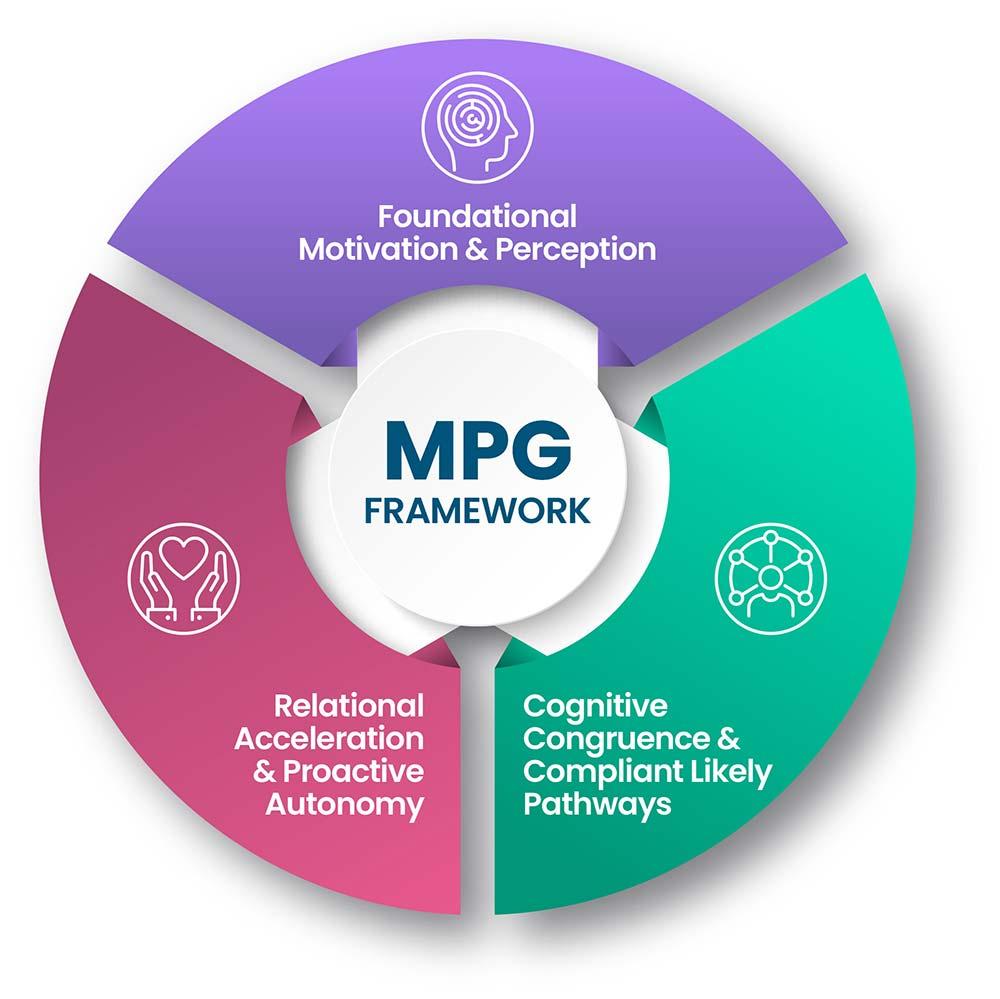
  • Foundational Motivation & Perception

    These building block techniques focus on uncovering patient motivations, shaping how they perceive risks and benefits, and normalizing healthy behaviors through peer examples.

    • Motivational Interviewing & Empathetic Inquiry
    • Contrast & Framing (Weber’s Principle)
    • Social Proof & Community Norms

    Learn More

  • Cognitive Congruence & Compliant Likely Pathways

    Here, the emphasis is on reducing friction, leveraging simple “yes” steps, and giving each patient a clear rationale so they see why each action matters—boosting compliance through comprehension.

    • Ease & Effort Minimization
    • Choice Architecture & Micro Commitments
    • Adult Learning & The Power of “Why”

    Learn More

  • Relational Acceleration & Proactive Autonomy

    These building blocks amplify the emotional and relational facets of patient activation—empathetic communication, mutual trust, shared decision making, and acts of unexpected kindness or goodwill that drive loyalty and patient follow through.

    • Relational, Persistent, Relevant & Timely Communication (Empathy + Trust + Respect)
    • Balanced Authority (Confidence) & Patient Voice
    • Reciprocity & Goodwill (“The Extra Mile”)

    Learn More

Through the MPG Framework, Guideway Transforms “Engagement” Into Activation

Instead of just sending reminders or information, we orchestrate a journey from initial patient interest to sustained action. The combination of specialized human support and AI-driven strategy—all guided by activation science-based principles—ensures that patients supported by Guideway don’t just promise to adhere, they follow through. This is the critical difference that leads to better health outcomes, lower costs, and a superior patient experience.

Motivational Patient Guidance Disciplines and Techniques

The three Motivational Patient Guidance macro disciplines, each encompassing three key activation techniques, work together to move patients from surface-level engagement to lasting activation.
By simultaneously addressing foundational motivation, cognitive simplification, and relational empowerment, the MPG Framework drives measurable improvements—fewer readmissions, near-perfect appointment adherence, higher patient satisfaction, and better overall health outcomes.
By combining these macro disciplines with individualized “micro” tactics—like empathetic interviews, micro commitments, or socially oriented motivation—Guideway Care orchestrates a fully tailored approach for each patient. This ensures both internal motivation (their “why”) and external support (removing barriers) are present, so patients truly activate and sustain the right health behaviors.
  • 1. Foundational Motivation & Perception

  • 2. Cognitive Congruence & Compliant Pathways

  • 3. Relational Acceleration & Proactive Autonomy

1—Foundational Motivation & Perception

The first MPG macro discipline focuses on uncovering each patient’s deeper motivations, framing risks versus benefits, and building the foundational mindset for behavior change.

Motivational Interviewing & Empathetic Inquiry

Motivational Interviewing & Empathetic Inquiry activation technique, rooted in self-determination theory and client-centered psychology, employs open-ended questions, reflective listening, and collaborative goal setting to respect patient autonomy, creating multi-dimensional motivation rather than relying on external pressure.
  • Builds deep trust and rapport
  • Encourages open disclosure of true barriers
  • Increases patient ownership and confidence in taking action

Contrast & Framing (Weber’s Principle)

Contrast & Framing activation technique illustrates the difference between “doing nothing” and “following the plan,” engaging loss aversion and relative perception. Patients see the immediate and long‑term impact of their choices, making the healthier option feel significantly more desirable.
  • Emphasizes tangible rewards or consequences
  • Drives patients to avoid the “cost” of inaction
  • Accelerates decision making for positive health behaviors

Social Proof &
Community Norms

Humans often look to peers when deciding how to act. The Social Proof & Community Norms activation technique demonstrates that “people like me” have succeeded, normalizing recommended actions and alleviating the fear of the unknown by tapping into Social Cognitive Theory.
  • Lowers resistance by showing that healthy behaviors are common
  • Creates a sense of belonging and reassurance
  • Boosts compliance by leveraging relatable success stories

2—Cognitive Congruence & Compliant Pathways

The second MPG macro discipline minimizes effort and structures choices so that following through on recommended tasks is the simplest and most likely path.

Ease & Effort Minimization

According to Fogg’s Behavior Model, the simpler an action is, the higher the likelihood of doing it. Ease & Effort Minimization activation technique removes friction—such as complex scheduling or unclear instructions—helping patients comply more consistently.
  • Creates a more streamlined patient experience
  • Reduces confusion and hassle
  • Prevents patients from dropping out due to logistical burdens

Choice Architecture & Micro Commitments

Nudge theory suggests that default options and small incremental “yes” steps mitigate decision fatigue. Auto scheduling or brief confirmation messages (“Reply YES to confirm”) build momentum, making adherence the natural choice.
  • Increases adherence by reducing the burden of decision making
  • Counters procrastination and uncertainty with clear, easy steps
  • Facilitates progressive engagement, each minor success fueling bigger ones

Adult Learning &
the Power of “Why”

Adults learn and retain best when it’s relevant to their own lives (Andragogy). The Adult Learning & Power of “Why” activation technique works by explaining how a specific health action benefits them personally, fostering deeper understanding and stronger commitment.
  • Cultivates self-driven compliance by revealing personal benefits
  • Reduces pushback by removing the sense of arbitrary instructions
  • Helps patients internalize the importance of each recommended task

3—Relational Acceleration & Proactive Autonomy

The third MPG macro discipline emphasizes trust, empathy, and shared decision making, ensuring patients feel respected, valued, and motivated to engage.

Relational, Persistent, Relevant & Timely Communication
(Empathy+Trust+Respect)

Activation psychology shows that empathetic interactions can reduce anxiety and enhance a patient’s sense of safety, while consistent, well‑timed outreach builds trust and ensures early detection of new concerns or obstacles.
  • Increases patient comfort and willingness to ask questions
  • Prevents feelings of isolation or confusion post-discharge
  • Reinforces an ongoing partnership that nurtures adherence

Balanced Authority (Confidence) & Patient Voice

Patients are more inclined to follow advice when it’s framed as expert guidance via the Balanced Authority activation technique, which still respects their autonomy. Shared decision making taps into individuals’ desire for control and recognition of their perspective.
  • Reduces resistance by involving patients in care choices
  • Builds mutual respect between patient and provider
  • Strengthens adherence due to a sense of co ownership of the plan

Reciprocity & Goodwill (“The Extra Mile”)

Reciprocity & Goodwill activation technique leverages social exchange theory by tapping into people’s tendency to reciprocate unexpected kindness. By helping patients with real world challenges (e.g., arranging transport, financial aid) before they ask, we trigger gratitude and loyalty.
  • Forges a strong emotional bond and sense of obligation to follow advice
  • Encourages long term commitment to the recommended care path
  • Boosts patient satisfaction, often reflected in higher HCAHPS scores

Key Elements of Motivational Patient Guidance

Five Key Motivational Patient Guidance (MPG) Elements for delivering “the right nudge at the right moment” activate each individual patient to improve clinical and business outcomes.
  • 1. Multi-Dimensional Motivation Focus

  • 2. Practical Barrier Removal

  • 3. Nine Behavioral Activation Techniques

  • 4. AI-Orchestrated Personalization

  • 5. Validated in Real-world Settings

1—Multi-Dimensional Motivation Focus

MPG begins by understanding each patient’s personal motivators and worries.
For example, one patient might be driven by fear of hospital bills (loss aversion) while another is motivated by the desire to stay independent at home. Our solution identifies these multi-dimensional motivators through assessments and conversation, then tailors messaging accordingly. This ensures that outreach isn’t one-size-fits-all but rather speaks to “why” each patient will take action.

2—Practical Barrier Removal

Information and motivation alone aren’t enough if a patient is blocked by real-life obstacles.
MPG therefore gives equal weight to Practical Ease—removing barriers like transportation, scheduling confusion, or financial constraints. For example, when required, we use an activation oriented, Stressor Inventory process; our Activation Agents uncover non-clinical issues (lack of a ride to the clinic, difficulty affording medications, etc.) and mobilize solutions proactively. By clearing these hurdles, we make it as easy as possible for patients to follow their care plan.

3—Nine Behavioral Activation Techniques

The MPG framework is built on 9 core behavioral techniques that drive action. Among others, these include methods like:
  • Motivational Interviewing to evoke patient goals and address ambivalence
  • Social Proof & Community Norms leveraging positive peer examples
  • Contrast & Framing highlighting the costs of inaction vs benefits of action
  • Choice Architecture & Micro-Commitments highlighting the costs of inaction vs benefits of action
Each technique is rooted in well-established psychology, and together they cover the full spectrum of persuasion and behavior change needed to move a patient from intention to adherence. Our Activation Agents are extensively trained in applying these MPG principles during patient interactions, ensuring every conversation or message is crafted to maximize its motivational impact.

4—AI-Orchestrated Personalization

The MPG framework is operationalized by our AI-powered Enterprise GPS platform, which acts as the brain continuously monitoring and guiding patient journeys.
The system performs Continuous Motivational Profiling—learning which messages resonate best with each patient (e.g. emphasizing avoiding a negative outcome versus gaining a positive reward). It also uses data-driven segmentation to determine the right intensity of support for each patient (some may just need an automated text, others a phone call or in-home visit). As new data comes in (e.g. a patient misses a call or reports a new concern), the AI rules engine adjusts the plan in real time, selecting the next best action or escalating to a human Activation Agent when needed. This dynamic, closed-loop system means patients get timely, context-aware support instead of static workflows.

5—Validated in Real-world Settings

The activation psychology-based MPG approach is not just theoretical. It has been tested and refined in real healthcare environments.
Each of the nine building blocks has demonstrated success in practice, and our platform has over a decade of patient data informing its rules. For example, using Ease & Effort Minimization tactics like scheduling follow-up appointments for patients (instead of leaving it to them) has dramatically improved appointment adherence. Techniques like Relational Communication (empathetic listening and rapid response) have led to greater patient trust and willingness to share issues—allowing problems to be solved before they lead to readmissions. This evidence-based refinement process means the MPG framework reliably produces activation success across diverse patient populations.

At Guideway Care, we do one thing exceptionally well—activate patients.

We Are the Patient Activation Company™

We are not just another digital engagement tool. We are the patient activation company that fuses cutting-edge AI technology with activation psychology techniques and highly trained human insight.
  • Choose Activation over engagement fatigue.
  • Choose Measurable Action over messaging volume.
  • Choose Guideway Care and turn every patient’s next step into a decisive stride toward healthier communities and stronger financial futures.

Close the Gap with Evidence-Based Patient Activation

It’s time to close the engagement gap in your organization.
Don’t settle for costly programs that maintain the status quo. Download our Short Guide to Evidence-Based Patient Activation to learn how Guideway Care can drive better outcomes and financial performance for you. See the data, case studies, and model behind this proven solution – and discover how to finally achieve the patient engagement breakthrough your team has been looking for. Get the guide now and start your journey to real patient activation and real results.

Evidence-Based Patient Activation Guide

Schedule a Strategic Analysis to Explore How Our EBPA Can Help You

Schedule Analysis

Continue reading

Evidence-Based Patient Activation Overview

Overview

Evidence-Based
Patient Activation

for Improving Financial and Clinical Outcomes

Activation Science That Delivers
Measurable Clinical & Financial Results
Engagement talks—Activation moves. Guideway Care fuses Activation Psychology, advanced data orchestration, and specialized human guidance to convert every patient intention into the next right action—reducing avoidable utilization, boosting satisfaction, and growing revenue for the organizations who serve them.

Download the Evidence-Based Patient Activation Guide

Download PDF

Continue reading

Motivational Patient Guidance and Activation Psychology Comprehensive Overview

Comprehensive Overview

Motivational Patient Guidance and Activation Psychology

Transforming Healthcare with Evidence-Based Patient Activation

At the core of Guideway’s success is our Motivational Patient Guidance (MPG) Framework—a science-based approach that systematically and reliably changes patient behavior.
Unlike typical digital engagement solutions, MPG is rooted in adult learning theory, behavioral economics, social psychology, and motivational interviewing.
  • Multi-Dimensional Motivation Focus

    We uncover what truly drives each patient (e.g., concern about hospital bills, desire for independence) and tailor our communication to that driver.
  • Practical Barrier Removal

    Along with motivation, we tackle logistical or financial hurdles (transport, childcare, confusion over instructions). By clearing these barriers, we ensure each patient’s “path to yes” is smooth.
  • Motivational Behavioral Building Blocks

    MPG is built on 9 proven activation techniques organized into 3 macro disciplines: (1) Foundational Motivation & Perception, (2) Cognitive Congruence & Compliant Pathways, and (3) Relational Acceleration & Proactive Autonomy.
  • AI-Orchestrated Personalization

    Our Enterprise GPS platform continuously profiles motivational cues, segments patients by risk and preference, and prompts the correct next-best-action. The system monitors changes (like missed calls or new concerns) and adapts in real time—no static workflows.
  • Validated in Real Settings

    MPG is grounded in real data from a decade of patient interactions, delivering consistent success in diverse populations.
  • True Activation

    By weaving motivational tactics with practical assistance, Guideway transforms “engagement” into true activation—meaning patients go beyond passive agreement to active follow-through.

Comprehensive Overview of Motivational Patient Guidance And Activation Psychology

Download PDF

Continue reading